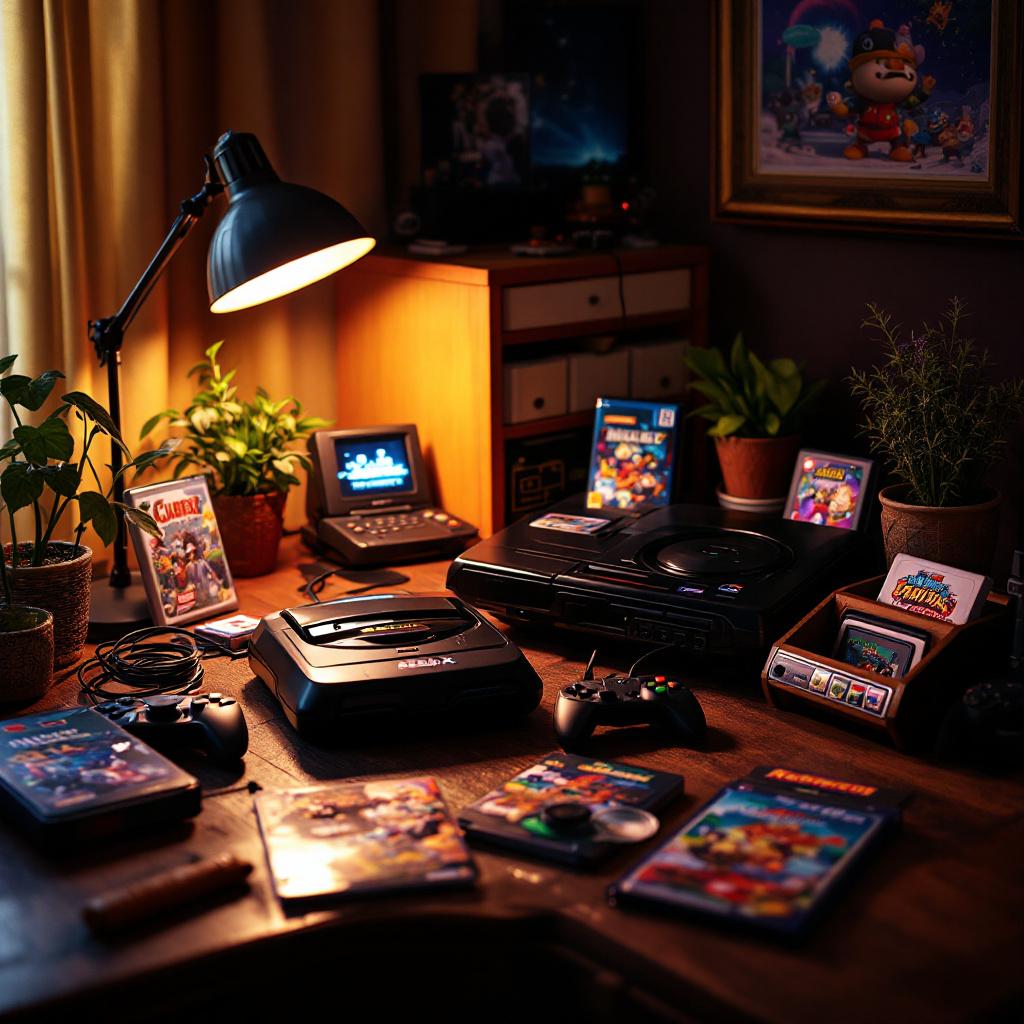
With the Mega-CD and the 32X, Sega attempted to extend the life of its Mega Drive by riding the wave of CD-ROM and 32-bit technology. These peripherals promised improved graphics, CD-audio music, and an entry into the digital era. Yet, neither the richness of the catalog nor the additional power was enough to convince an audience already divided between competing consoles and home computers. A look back at add-ons that left a mark with their boldness… before disappearing.
Sommaire
In brief
🕹️ Two extensions: the Mega-CD provided CD-ROM support, while the 32X added a 32-bit architecture. They tried to extend the life of the Mega Drive.
💾 Technical specifications: the Mega-CD used a Motorola 68000 processor at 12.5 MHz and up to 6 MB of CD data; the 32X housed two SH2 processors at 23 MHz and 256 KB of video RAM.
📉 Commercial failure: launched between 1991 and 1994, these add-ons suffered from a chaotic schedule, fierce competition (SNES, PC Engine CD, Philips CD-i), and a market already turning towards the Saturn and PlayStation.
🔍 Mixed legacy: today, some collectors seek the technical gems on CD, while the 32X remains a memory of a strategy too confused to attract lasting appeal.
Context and genesis of the extensions
At the end of the 1980s, Sega timidly dominated the market with the Master System, but Japanese competition was intensifying. Nintendo was preparing the Super NES, NEC was betting on the PC Engine, and Philips was developing the CD-i. In this context, Sega had to innovate quickly. The company had already experimented with the Sega SG-1000 / Mark III, technical ancestors of the Mega Drive and described in another article on the history of consoles. Rather than launching a new console directly, Sega chose to extend its Mega Drive through two distinct modules, each tasked with responding to a budding aspiration: CD-ROM on one side, 32-bit on the other.
Sega Mega-CD: the CD-ROM bet
Architecture and characteristics
| Specification | Mega-CD |
|---|---|
| Main processor | Motorola 68000 at 12.5 MHz |
| Main RAM | 1 MB (512 KB video + 512 KB audio) |
| Storage | CD-ROM support (650 MB) |
| Audio | CD-Audio + 8 PCM channels |
| Connection | Cartridge port + memory card slot |
This configuration made the Mega-CD one of the first consoles to exploit CD-ROM, allowing for long audio sequences and cinematics. Developers could break free from cartridge size constraints and offer more cinematic experiences, provided they managed the loading times inherent to the disc reader.
Performance and catalog
The Mega-CD catalog mixed video game adaptations (Sonic CD, Lunar: The Silver Star), original games, and interactive experiences. By comparison, NEC’s PC Engine CD-ROM² had launched the movement a year earlier but with a smaller installed base outside Japan. In Western regions, the Philips CD-i suffered from high prices and unconvincing games. Yet, the Mega-CD struggled to find its audience: the additional cost and lack of exclusive killer apps hindered sales.
The Sega 32X: 32-bit accelerator in a sleight of hand
Specifications and Compatibility
- Processors: two SH2 clocked at 23 MHz
- RAM: 256 KB video, 256 KB audio
- Graphics: 32,000 color palette, enhanced hardware sprites
- Compatibility: backward compatible with all Mega Drive games
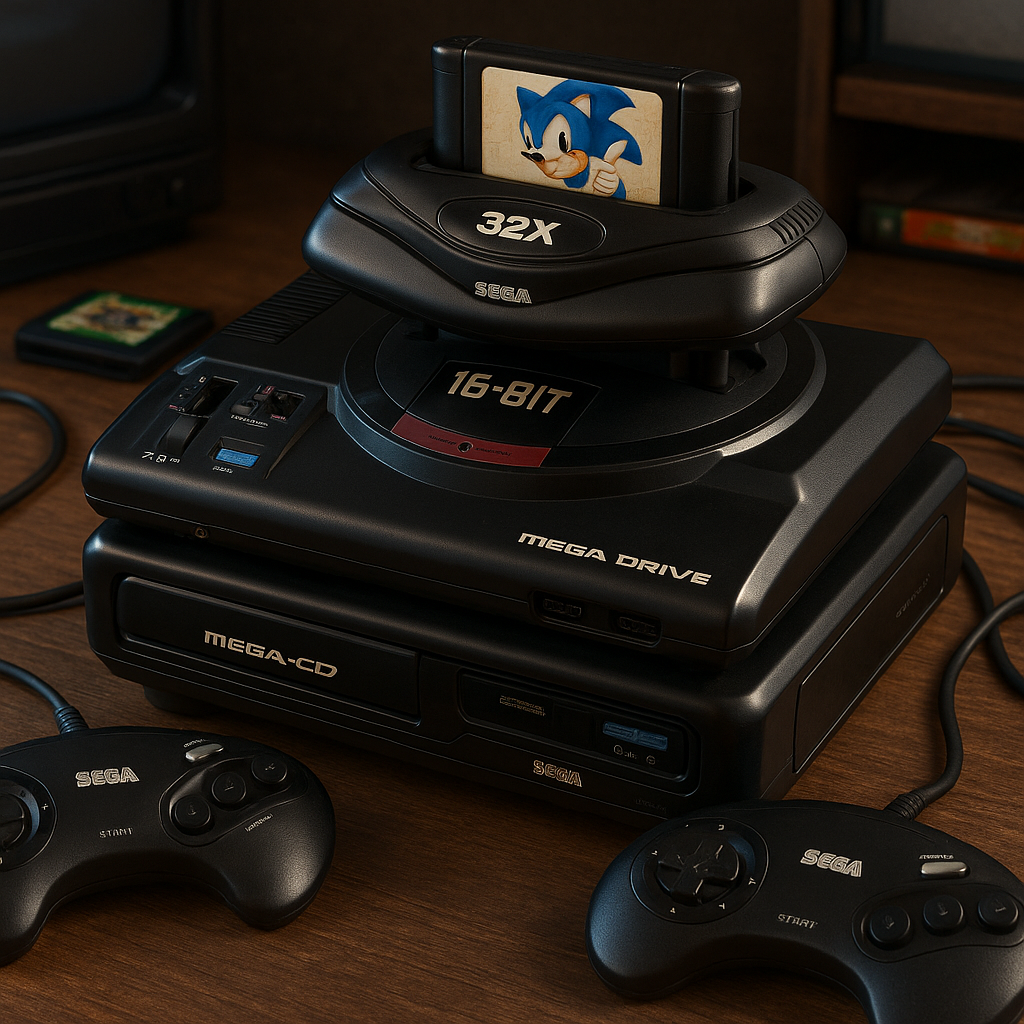
The 32X plugged on top of the Mega-CD module or directly onto the console. Its promise: to transform the Mega Drive into a 32-bit machine at a lower cost, without forcing the player to change platforms. In practice, the performance was significantly improved, but limited by the main bus bandwidth and the lack of perfect synchronization between the two SH2 processors.
Critical and Commercial Reception
Released at the end of 1994, just before the arrival of the Saturn, the 32X quickly appeared as a gadget whose lifespan seemed insufficient. Third-party publishers were divided: a few titles like Virtua Racing Deluxe demonstrated the potential, but most games remained slightly modified ports, without real exploitation of the 32-bit capabilities. Meanwhile, the announcement of the Sega Saturn and the PlayStation further shook consumer confidence.
Competition and Market Impact
In the market, Nintendo relied on the console timeline and an integrated hardware strategy, with the Super NES then the Nintendo 64. NEC dominated in Japan with the PC Engine CD. Philips was fading with the CD-i. Ultimately, Sega found itself caught between its own past and a more promising future hardware, with no room for intermediate add-ons.
Why Were These Extensions Doomed to Fail?
Technological Gap
In two years, technology evolved rapidly: the Saturn, the PlayStation, and even some consumer PCs offered better 3D and CD-ROM performance. Players sought novelty, not a half-boosted Mega Drive.
Marketing Strategy and Chaotic Schedule
Sega launched the Mega-CD before announcing the Saturn, then the 32X before clearly communicating about its successor. Players, confused, hesitated between investing in an add-on or saving for a next-gen console. This confusion revived old scars from costly past experiments.
Legacy and Current Perception
“Poorly designed commercially but fascinating for hardware enthusiasts, these add-ons illustrate Sega’s creativity and mistakes.”
Today, the Mega-CD attracts collectors for its rich soundtracks and special editions. The 32X remains a symbol of a disorganized strategy, while still holding some gems to rediscover. Their failure partly explains how quickly Sega moved on to the Saturn and, later, the Dreamcast.
Technical Sheet
| Criteria | Mega-CD | 32X |
|---|---|---|
| Release Year | 1991 (Japan) / 1992 (West) | 1994 |
| Processor | Motorola 68000 @12.5 MHz | 2× SH2 @23 MHz |
| RAM | 1 MB (audio/video) | 512 KB (video/sound) |
| Media | CD-ROM | Cartridge |
| Initial Price | €299 | €199 |
FAQ
- Why didn’t Sega combine the Mega-CD and 32X from the start?
To limit costs and test two technologies separately, but the lack of synergy penalized the overall experience. - Was the Mega-CD really worth it in terms of audio?
Yes, with CD-Audio soundtracks and quality samples, it set the bar for consoles before the era of enhanced sound cartridges. - Are there any standout titles on the 32X?
Virtua Racing Deluxe, Star Wars Arcade, and Doom remain among the most accomplished, although the overall game library is limited. - Do these extensions work on emulators?
Several emulators today support the Mega-CD and 32X, but performance may vary depending on the setup.
