
Software emulation endures thanks to its **flexibility**, **accessibility**, and the **richness of its ecosystem**, even though the Mister FPGA offers an appealing hardware approach. Beyond raw performance, the open-source community and portability guarantee a solid and evolving future for software emulation.
Sommaire
In brief
🎯 Software emulation = rapid and cross-platform adaptation, no need for dedicated hardware to test dozens of retro consoles.
💡 The open-source community continuously maintains and improves emulators, ensuring regular updates and broad compatibility.
⚙️ Mister FPGA shines with its hardware accuracy, but software emulation remains unbeatable in terms of cost and software innovation.
🚀 In the future, the two approaches will converge: FPGA for accuracy, emulation for experimentation and rapid development.
Context: Software Emulation vs FPGA
Origins and evolution of emulation
Software emulation emerged in the 1980s, initially as an academic feat before becoming a cornerstone of retro gaming. Over the decades, projects like MAME or Dolphin have demonstrated that it is possible to faithfully reproduce the behavior of complex hardware through pure code. In parallel, FPGAs (Field-Programmable Gate Arrays) have emerged as configurable hardware solutions capable of reproducing the logic circuits of consoles in real time. The Mister FPGA popularizes this trend, offering a near-authentic experience. Yet, software does not fade away: it evolves, diversifies, and attracts millions of users.
How software emulation works
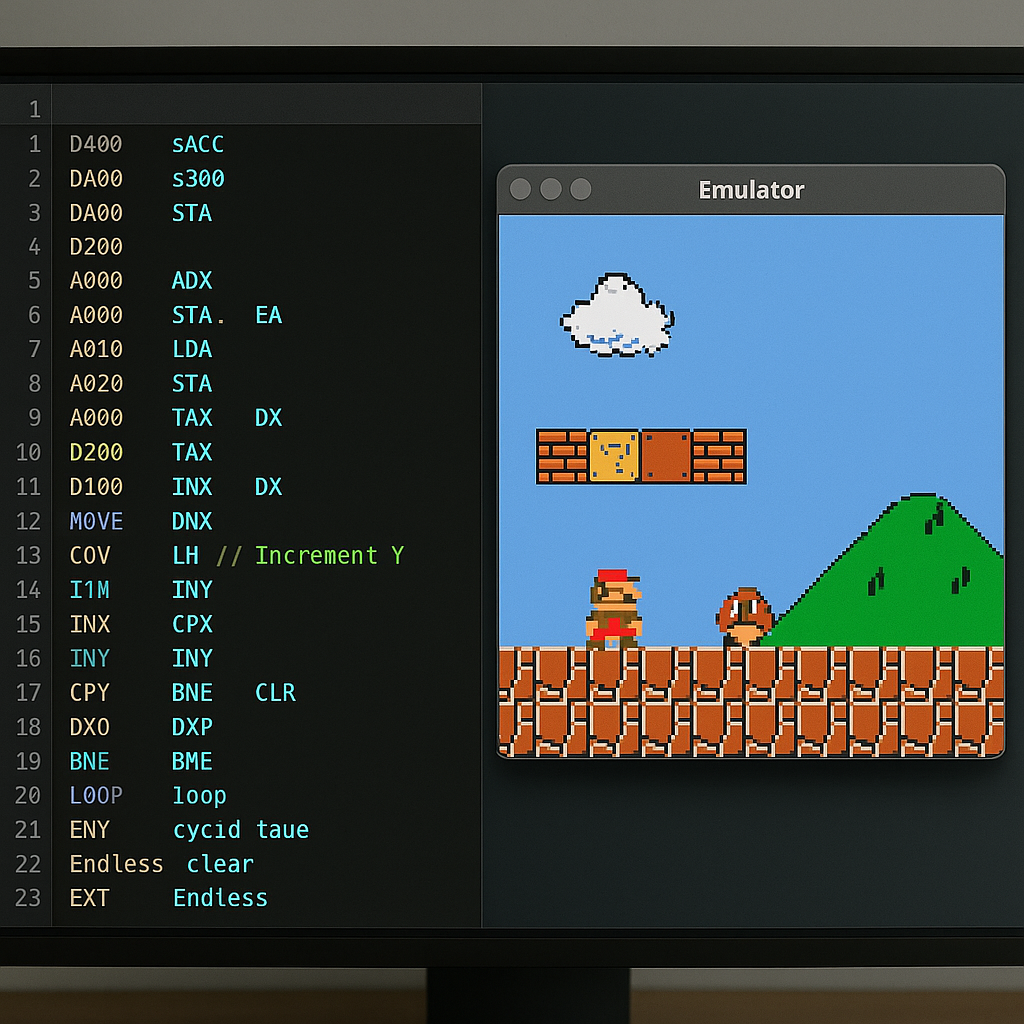
A software emulator interprets or just-in-time compiles the binary code of a console to translate it into executable instructions on a PC, smartphone, or any other device. This abstraction layer involves overhead, but advances in JIT (Just-In-Time compilation) and CPU optimizations have reduced the performance gap. Emulation relies on modules, each managing a component: processor, GPU, sound, inputs. This modularity facilitates adding features like rewind, shaders, or video capture, making the experience richer than on native hardware.
Enduring advantages of software emulation
Software emulation retains unique strengths that are unlikely to vanish quickly. Beyond mere nostalgia, it embodies a solution adaptable to an infinite number of scenarios.
Flexibility and evolvability
Unlike an FPGA programmed once and for all, a software emulator can be continuously updated. Developers add new consoles, fix bugs, improve accuracy, or integrate novel features. You can switch from a NES game to a Dreamcast title in a few clicks without changing hardware. This rapid adaptation capability is a strategic advantage, especially for enthusiasts who want to juggle multiple generations of machines.
Community and Ecosystem
The success of software emulation relies on a dispersed but very active community. Forums, GitHub repositories, Discord channels: exchanges abound, and everyone can contribute. This collaborative dynamic ensures continuous fixes and innovations. An FPGA platform may appeal with its plug-and-play aspect, but it does not offer the same freedom to experiment with new ideas, create plugins, or adapt the user interface.
Compatibility and Portability
A software emulator runs on Windows, macOS, Linux, Android, and even some web browsers. Developers test and package their software to reach as many users as possible. You don’t need a specific card or a dedicated case: a simple computer or smartphone is enough. This universality is a major lever to reach new audiences, from computer science students to curious collectors.
The Role of Mister FPGA: Complementary Innovation
Performance and Precision
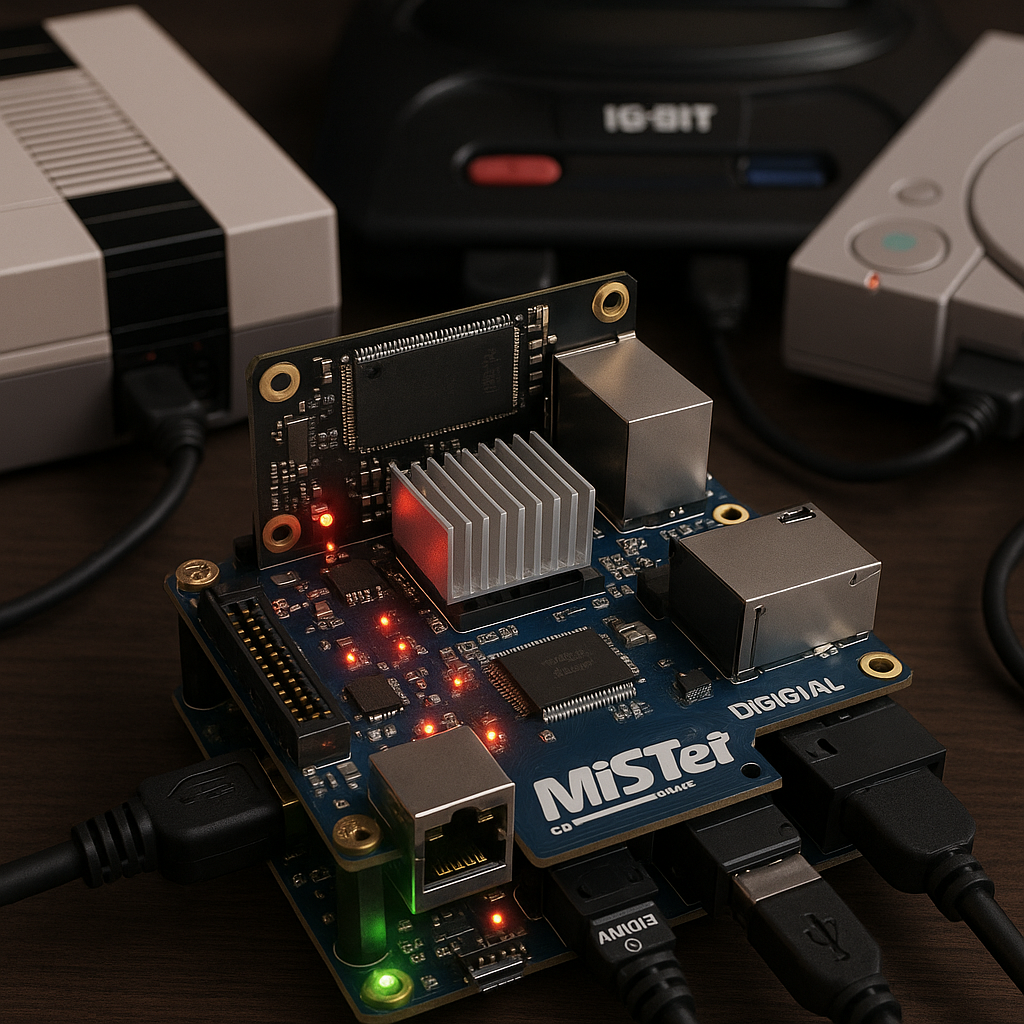
The Mister FPGA stands out for its ability to reproduce the operation of electronic circuits down to the nanosecond. Each virtual transistor is recreated, which almost entirely eliminates latency and approximations. For purists, this technical aspect is a game-changer: they regain the exact behavior of the original machines, without jitter or artifacts.
Use Cases and Niche
The Mister FPGA appeals to hardware and DIY enthusiasts, ready to invest in a platform that combines authenticity and robustness. It is often used for technical demos, speedrun competitions, or museum installations. But its cost, the time investment to master the configuration, and the lack of rewind tools make its adoption more limited than mainstream software emulation.
Why Software Emulation Will Persist
The reasons why software emulation continues to thrive go far beyond nostalgia: they touch on economics, innovation, and user aspirations.
Economy and Accessibility
Installing an emulator often costs less than ten euros, or even nothing at all. No shipping fees, rare components, or expensive licenses. This economic dimension is decisive in a context where the budgets of players and amateur developers are often tight. The barriers to entry are almost nonexistent: a PC you already own is enough to explore a complete universe of old consoles.
Technological Evolution
CPU and GPU architectures progress at high speed, offering comfortable leeway to improve emulation without sacrificing smoothness. Developers can integrate VR compatibility, 4K filters, or even AI to automatically upscale textures. These software innovations, impossible to deploy on an FPGA without recompiling the entire hardware design, offer unmatched flexibility.
Vision for the Future and Synergies
Rather than a direct opposition, software emulation and FPGA hardware sometimes converge: some projects combine the interface of a software emulator with an FPGA core to handle critical calculations. In this hybrid model, the user benefits from the best of both worlds: development speed, advanced features, and hardware precision.
In practice: choosing your environment
For a curious player, installing an emulator (RetroArch, PCSX2, Citra…) is an immediate reflex. For a hardware enthusiast, the Mister FPGA represents a technical and aesthetic challenge. Depending on your priorities — cost, fidelity, features — one or the other is justified. You can even start with software emulation and switch to FPGA for your most advanced projects.
| Criterion | Software Emulation | Mister FPGA |
|---|---|---|
| Cost | Free or low | 150–300 € |
| Updates | Daily/weekly | Rarely |
| Fidelity | Very good (depending on optimization) | Almost perfect |
| Features | Rewinding, shaders, captures | Strictly hardware |
« Software emulation embodies the art of the possible: it adapts faster than any reconfigurable chip. »
– Dr. Élise Martin, researcher in retro-engineering
FAQ
- What is software emulation?
It is the reproduction in code of the behavior of hardware (console, computer) to run it on a different platform. - Why prefer an emulator over an FPGA?
For its reduced cost, portability, and the richness of software features (rewinding, shaders, mods). - Is the Mister FPGA obsolete?
No: it remains prized for its fidelity and hardware approach, but it does not replace mainstream software emulation. - Can emulation and FPGA be combined?
Yes, some hybrid projects integrate an FPGA core controlled by a software interface to mix performance and flexibility. - Is software emulation legal?
It is if you own the original hardware or the corresponding ROM licenses; distributing unauthorized ROMs remains illegal. - Which emulators are recommended?
RetroArch, Dolphin, PCSX2, Citra: all offer regular updates and broad community support. - What is the future of emulation?
AI for upscaling, virtual reality, and cloud interfaces will enrich software emulation, making it ever more versatile.
