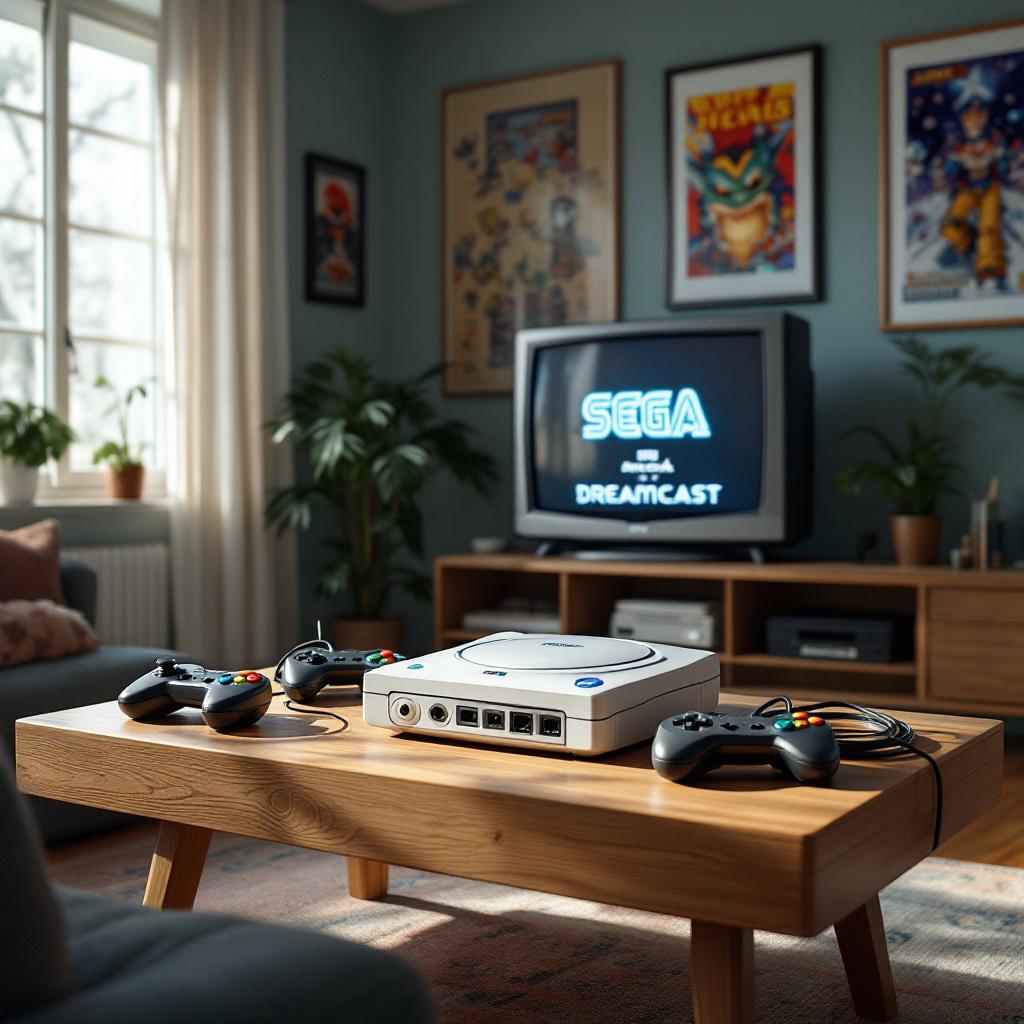
The Dreamcast marks Sega’s last release in the console war. When it arrived at the end of 1998 in Japan, it embodied the peak of a decade of innovations and fierce battles against Nintendo and Sony. Despite a promising start, the winds quickly changed: financial problems, departure of third-party publishers, imminent arrival of the PlayStation 2… Nevertheless, the little gray box had not said its last word and has transformed into a cult object among enthusiasts.
🚀 Release: November 27, 1998 (Japan), September 9, 1999 (US), October 14, 1999 (Europe). CPU 200 MHz, VRAM 16 MB, GD-ROM.
🎯 Innovative: VMU memory, integrated 56k modem, first mainstream console to surf online.
🎮 Rich game library with Sonic Adventure, Shenmue, Jet Set Radio, Skies of Arcadia… Titles that remain references.
⚠️ Commercial discontinuation in March 2001 facing the PS2. Yet, the appeal for the hardware and games never faded.
Sommaire
Genesis and launch of the Dreamcast
In the mid-90s, Sega suffered from the flop of the Saturn, weighed down by its complex architecture and high price. The minds at Sega AM2, led by Yu Suzuki, then worked on a more accessible and dismantlable machine. Goodbye to the Saturn’s dual-CPU chip: welcome a Hitachi SH-4 processor clocked at 200 MHz, complemented by a PowerVR2 for streamlined 3D graphics. This combination aimed to give Sega an edge, both technically and commercially.
Legacy of the Saturn
The Saturn taught Sega that complexity can become a hindrance. Developers, uncomfortable with the dual chip, often abandoned ambitious ideas. For the Dreamcast, the goal was clear: simplify the architecture to attract both internal studios and third-party publishers, a sine qua non condition to avoid a meager catalog.
A pioneering architecture
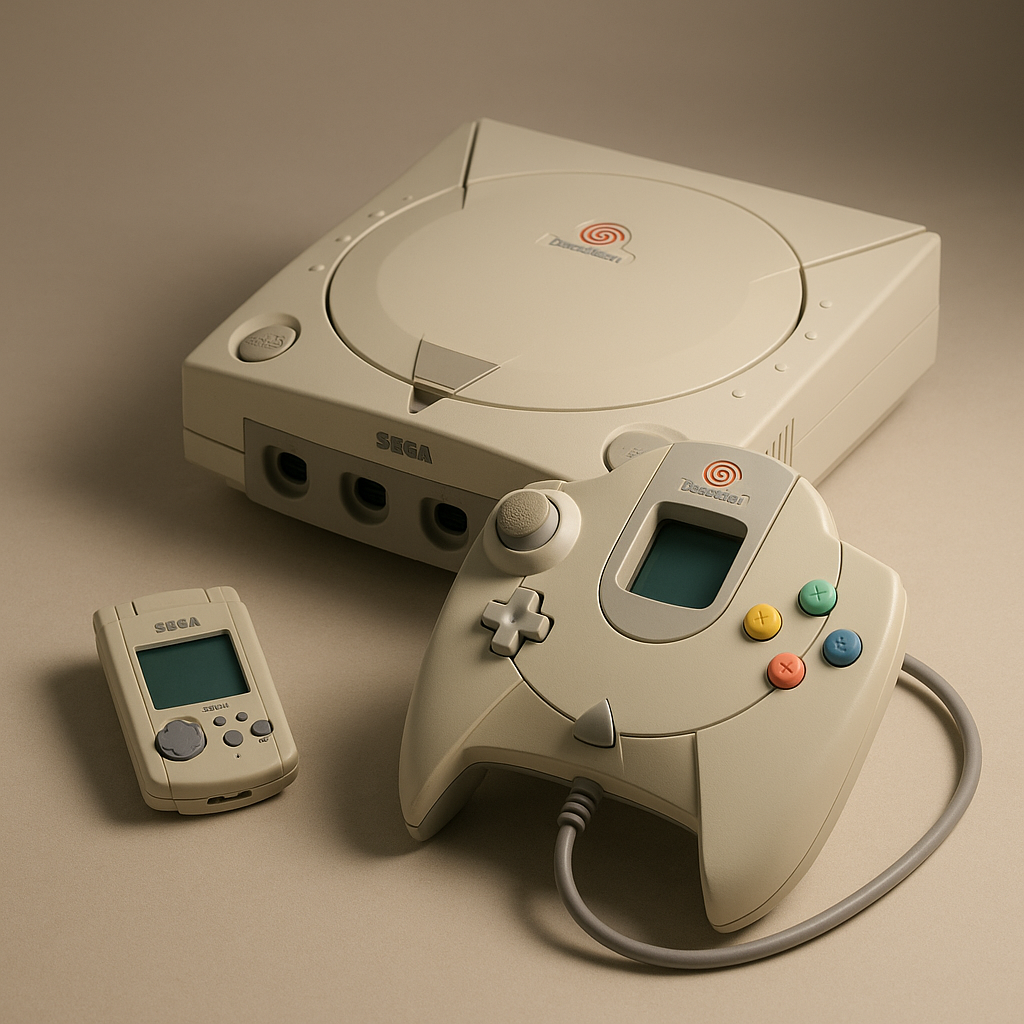
The Dreamcast stands out for its CPU/GPU coupling, generous RAM, and especially a GD-ROM support capable of holding up to 1 GB of data, equivalent to 5 audio CDs. Players enjoy a display of 640×480 pixels, up to 16.7 million colors, and 64-channel stereo sound. The cherry on top: the VMU (Visual Memory Unit) acts as a memory card and a mini portable console, offering mini-games and an enhanced interface.
Technical specifications
| Component | Specification |
|---|---|
| CPU | Hitachi SH-4 @ 200 MHz |
| GPU | PowerVR² |
| RAM | 16 MB (main) + 8 MB (video) |
| Storage | GD-ROM (1 GB) |
| Support | VMU, memory card |
| Connectivity | Integrated 56k modem, LAN |
| Release date | 1998–1999 depending on regions |
Competition and Technical Environment
At the dawn of the new millennium, the consumer PC adopts the Pentium III and powerful 3D cards, while Sony prepares its PlayStation 2 equipped with a powerful Emotion Engine chip. In this context, the Dreamcast maintains its strengths with an aggressive price and its online services. To trace this exciting evolution, one can refer to the history of video game consoles.
On the home console side, Sega also capitalizes on its past: the Mega Drive, highlighted by an aggressive marketing campaign, had given a second wind after the Master System era. The Dreamcast aims to repeat this feat… without really succeeding.
The Game Library: Gems and Exclusives
The richness of the Dreamcast catalog is based on a few flagship titles:
- Sonic Adventure: dive into Sonic’s ultra-colorful world with unprecedented 3D panoramas.
- Shenmue: the first true cinematic “open world,” with dynamic weather and neighborhood life.
- Jet Set Radio: brilliant cell-shading graphics and a funk soundtrack, a pure UFO.
- Skies of Arcadia: aerial role-playing game, cel-shading atmosphere, epic journey.
Decline and Market Withdrawal
Despite encouraging beginnings, the Dreamcast suffers several setbacks: massive departure of third-party publishers to the PS2, Sega’s communication deficit, easy piracy of GD-ROMs… In March 2001, Sega announces the end of production and definitively withdraws from the console sector to reposition itself as a publisher. The page turns, giving way to a paradoxical legacy: hardware too advanced for its time, sold at only 9.5 million units.
A Cult Status Today
Overall, the Dreamcast now benefits from an almost mystical aura. Collectors hunt for limited editions, players appreciate emulators, and enthusiasts still organize online tournaments via private servers. The commercial failure turned cult has transformed into a legend, proving that a machine is not limited to its sales figures.
FAQ
Why did the Dreamcast fail despite its innovations?
Several factors combined: competition from the PS2, Sega’s financial difficulties, lack of support from publishers, and piracy of GD-ROMs. These pitfalls stifled its potential before it could even reach a critical mass of players.
What makes the Dreamcast’s game library unique?
The Dreamcast hosts pioneering titles like Shenmue and Jet Set Radio, which inaugurated new artistic and technical directions. The VMU adds an original playful dimension with portable mini-games.
Can you still play online on Dreamcast?
Yes, thanks to private servers and community interfaces, one can experience the original online experience or simulate it via compatible third-party modules.
