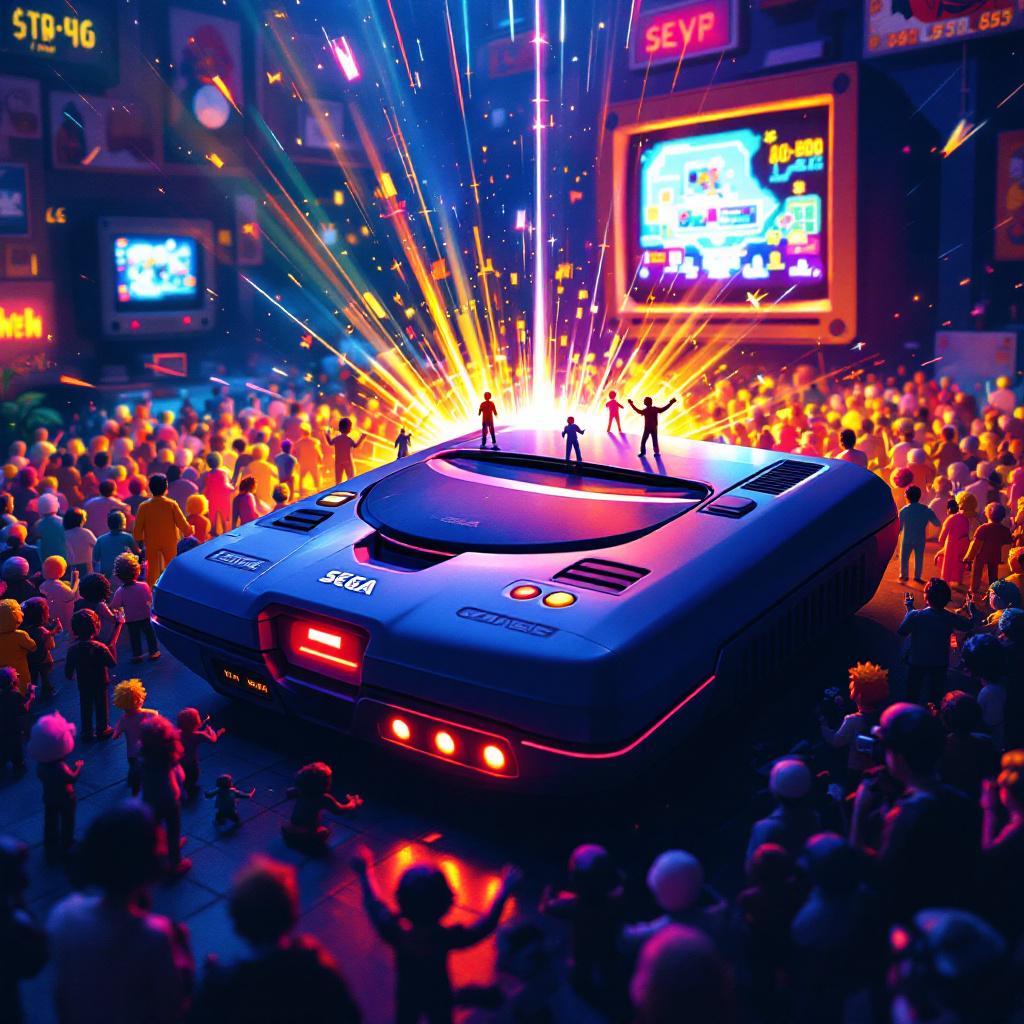
At the dawn of the 1990s, Sega shakes up the video game industry with its Mega Drive (renamed Genesis in the United States). In a market where Nintendo has reigned supreme since the end of the 1983 crash, the Japanese company chooses a decidedly provocative tone to assert itself. But behind the striking slogans and flashy advertisements lies a half-won revenge: notable success, intense rivalry, and a prominent place in history, while still being outpaced in some areas.
🕹️ Shock strategy: Sega bets on a provocative discourse and memorable TV spots to differentiate itself.
⚖️ Direct rivalry: the console openly challenges Nintendo, playing the card of 16-bit modernity.
🔧 Technical features: Motorola 68000 processor, stereo sound, custom cartridges.
🏁 Relative success: millions of units sold, but never dethroning the market king.
Sommaire
1. Genesis and launch context
In 1988, Sega Europe and Sega of America scout the field to launch a 16-bit console capable of shaking up the status quo. The machine, designed in Japan, is optimized to deliver finer graphics and richer sound than a simple 8-bit. Meanwhile, on the personal computer side, models like the Amiga 500 or the Commodore 64 refresh usage by offering home creations or arcade game adaptations. This emulation between consoles and micros contributes to a true evolution of consoles marked by the diversification of gaming experiences.
2. Technical sheet
| Element | Detail |
|---|---|
| Main processor | Motorola 68000 at 7.67 MHz |
| Co-processor | Zilog Z80 (sound) |
| RAM | 64 KB |
| Media | ROM cartridges |
| Graphics | Resolution up to 320×224 pixels, 512 color palette |
| Sound | Stereo, 10 FM channels |
3. Aggressive marketing: a precise strategy
3.1 Striking advertising campaigns
Sega plays the contrast card with televised spots where a teenager is called “anti-fun” if he does not own the console. The slogans follow one another: “Genesis does what Nintendon’t” in the United States, posters openly challenging the competition, and even flyers distributed near trade shows. Each message aims to establish the Mega Drive as the boldest and most frenetic console of the moment.
3.2 Sponsorship and partnerships
Beyond traditional media, Sega invests in the world of sports and pop culture. From skateboard teams to young rappers, all embody the “cool attitude” that the brand seeks to convey. Result: the Mega Drive becomes an object of desire, not only for its game library but also for an entire generation seeking a trendy identity.

4. The Console War and Computer Competitors
In the race for performance, Sega found itself facing Nintendo with its Super Nintendo Entertainment System, but also against desktop and home computers. The Amiga 500 and Atari ST stood out for their flexibility (integrated audio tracker, emulation) and attracted independent developers. In contrast, the Mega Drive focused on exclusivity: flagship titles like “Sonic the Hedgehog” became heavy-hitting arguments to justify the purchase. This tactic recalls the post-crash renaissance of 1983, where Nintendo regained public trust after the video game crash.
5. Partial Victory: Assessment and Legacy
While the Mega Drive claimed over 30 million sales worldwide, it failed to dethrone the SNES in the long term. The colossal advertising budgets ate into margins, and some geographic areas remained resistant to the overly aggressive messaging. Yet, the Genesis gained ground in North America, benefiting from an image of a “mature” and “urban” console.
Technically, developers still praise the simplicity of the cartridge and the power of the Motorola 68000. Titles like “Gunstar Heroes” or “Shining Force” demonstrate the possible gaming richness, while laying the groundwork for 20th-century communication where marketing became a full-fledged weapon.
“Sega proved that you can sell a console almost through provocation, relying more on attitude than on technical specifications.”
– Excerpt from an interview with Mark Cerny, 1991
6. FAQ
What made Sega’s marketing so aggressive?
The spots and slogans broke usual advertising codes by targeting rivalry and adrenaline, rather than just family or casual players.
Why is it called a partial victory?
Despite notable success, the Mega Drive never equaled Nintendo’s global dominance and had to contend with very high marketing costs.
How did the Mega Drive position itself against the computers of the time?
It offered a more accessible plug-and-play experience, while the Amiga or PC were also aimed at creation and programming.
