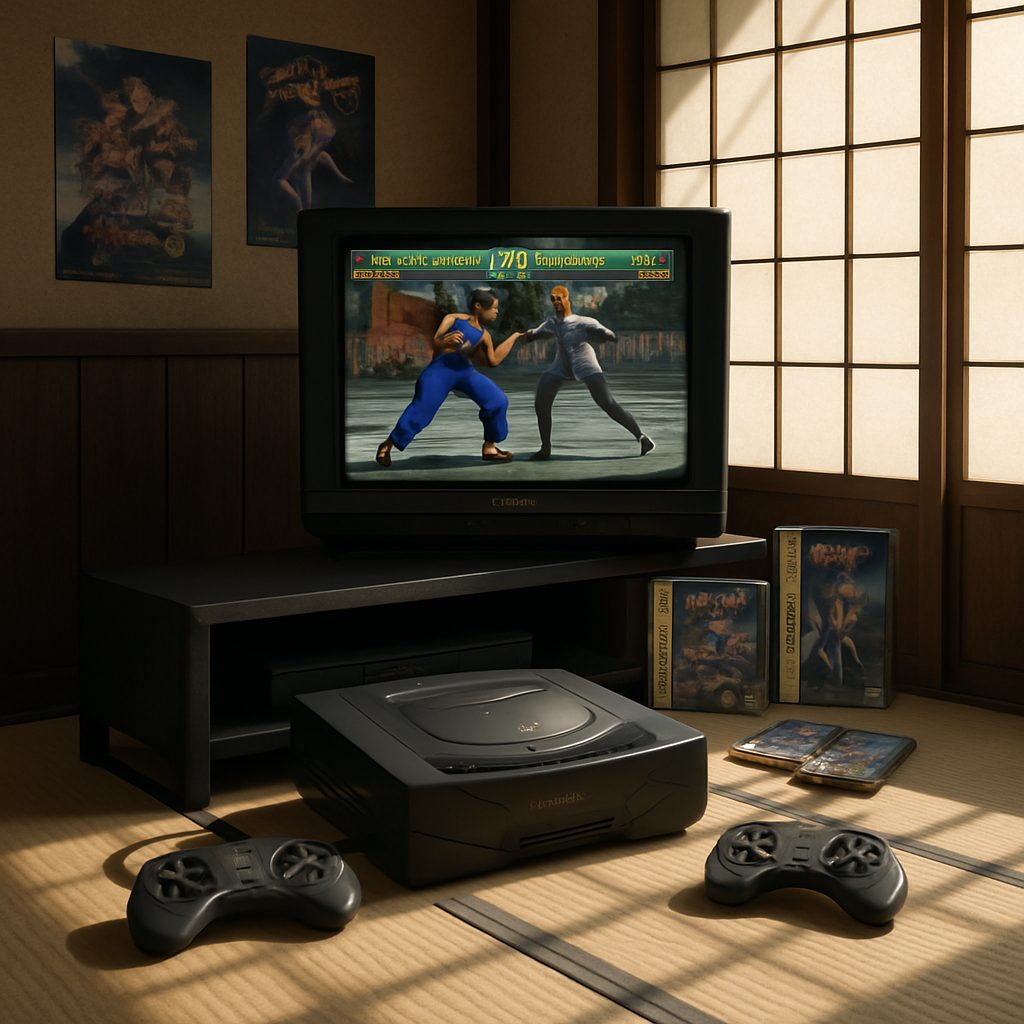
In 1994, while the video game world was shifting into the 32-bit era, Sega unveiled the Saturn: a technological gem doomed to commercial failure in the West, but crowned with success in Japan. Behind its complex facade lay fascinating exclusives and a cutting-edge architecture that has never ceased to captivate enthusiasts.
🎦 Innovative 32-bit: dual SH-2 processors and 5 dedicated core architecture, paving the way for unprecedented graphics.
🇯🇵 Japanese success: over 5 million units sold thanks to exclusive titles like Night Warriors and Virtua Fighter.
⚙️ Dense technical specs: main processor at 28 MHz, 2 MB main RAM, and CD-ROM support.
🏆 Lasting impact: its innovations influenced the next generation, from Dreamcast development to modern engines.
Sommaire
The origins of an ambitious console
At the end of the 1980s, Sega trembled before the dominance of Atari and Nintendo. The Master System struggled to establish itself, the Mega Drive had mixed success outside North America and Europe. Faced with this challenge, Sega Japan’s management launched a bold project: to create a 32-bit machine capable of competing with popular microcomputers — Commodore Amiga and compatible PCs. The idea? Combine computing power and CD-ROM support to offer unprecedented visual and sound experiences.
Technical specifications
| Component | Specification |
|---|---|
| Main processor | 2× Hitachi SH-2 @ 28 MHz |
| GPU | VDP1 & VDP2 dedicated to sprites and backgrounds |
| RAM | 2 MB main, 1 MB video, 1 MB audio |
| Storage | CD-ROM (550 MB) + optional cartridges |
| Audio | Yamaha SCSP, 32 channels |
| Peripherals | 6-button controller, multitap |
A cutting-edge but challenging architecture to exploit
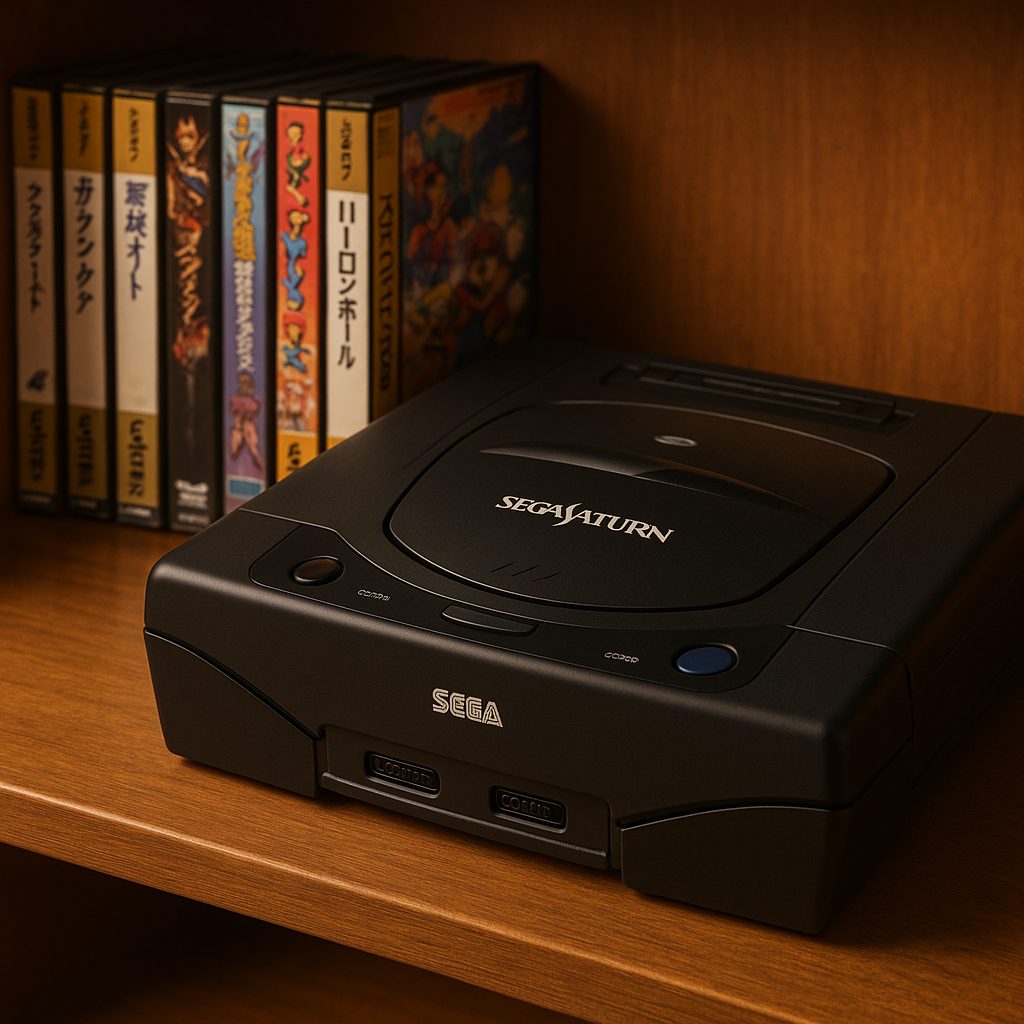
One might think that aligning two mainframe CPUs guarantees performance and ease of development — in truth, it was quite the opposite. The SH-2 was powerful for its time, capable of advanced vector calculations, but coordinating between the VDP1 (sprites) and the VDP2 (background tiles) required software gymnastics rarely mastered by Western teams.
Dual-core CPU
Each SH-2 performs up to 50 MIPS, a feat for 1994. But parallel programming requires fine management of shared memory: a rare challenge on consoles and familiar to PC developers.
GPU in tandem
The VDP1 manages moving objects, while the VDP2 sculpts the scenery. Their synchronization allowed rotation and 2D scaling effects close to 3D rendering, long unique to the Saturn.
Immersive audio
With 32 channels and CD-quality samples, the Saturn delivered rich soundscapes, rivaling the best PC sound cards of the era.
The Console War and Computer Competition
At its launch, the Saturn had to face Sony and its PlayStation, but also the Amiga 1200 and PCs equipped with emerging graphics cards. At Atari, the Jaguar — described as “64-bit” — struggled to convince despite its promises, reflecting an industry in full restructuring Atari Jaguar. Nintendo, for its part, was already preparing its transition to 3D with the Nintendo 64. Developers, torn between platforms, often favored the PlayStation, which was easier to handle.
Why Japan Succumbed to the Saturn
In the Land of the Rising Sun, Sega played on both fronts: sports sponsorship, TV ads, and a Japan-made game library rich with gems. Panzer Dragoon surprised with its futuristic settings, Sega Rally offered unprecedented realism in the “rally” genre, and Virtua Fighter, the first true polygonal 3D, attracted a wide audience. This alchemy between marketing and niche exclusives propelled the Saturn ahead of the PlayStation during the first two years.
A Thwarted Destiny in the West
In our regions, the Saturn suffered from its rushed release (in the United States as early as June 1995) and chaotic distribution maneuvers. Stocks were too limited, pricing alignment poorly thought out, and communication deemed confusing. The general public, already won over by the PlayStation, turned to Sony’s machine, without always understanding the Saturn’s strengths. And yet, every copy sold was a victory for Sega’s engineering.
To measure the impact of this pivotal era, one can look back at the history of video game consoles and see how the Saturn influenced subsequent generations.
The Saturn’s Legacy Today
While the Dreamcast has often been celebrated as Sega’s swan song, the Saturn was the laboratory for many advances, from CD audio streaming to the early introduction of multitap support. Its influence can be found in some modern game engines that still use rendering techniques modeled on the VDP1/VDP2 Dreamcast: autopsy.
FAQ
- Why did the Saturn perform better in Japan than in the West?
The combination of exclusive games, aggressive marketing, and a more coherent release schedule won over Japanese players, who were less fragmented than the European and American markets. - What technical difficulties hindered developers?
The parallelism between two CPUs and the management of two GPUs required rare expertise, contrasting with the more straightforward programming of the PlayStation. - Did the Saturn have notable exclusives?
Panzer Dragoon, Nights into Dreams, and Virtua Fighter remained milestones, often unavailable in the West at their release. - What is the Saturn’s impact on modern consoles?
The early use of CD-ROM, multitap, and hybrid 2D/3D rendering techniques were adopted by many manufacturers thereafter.
