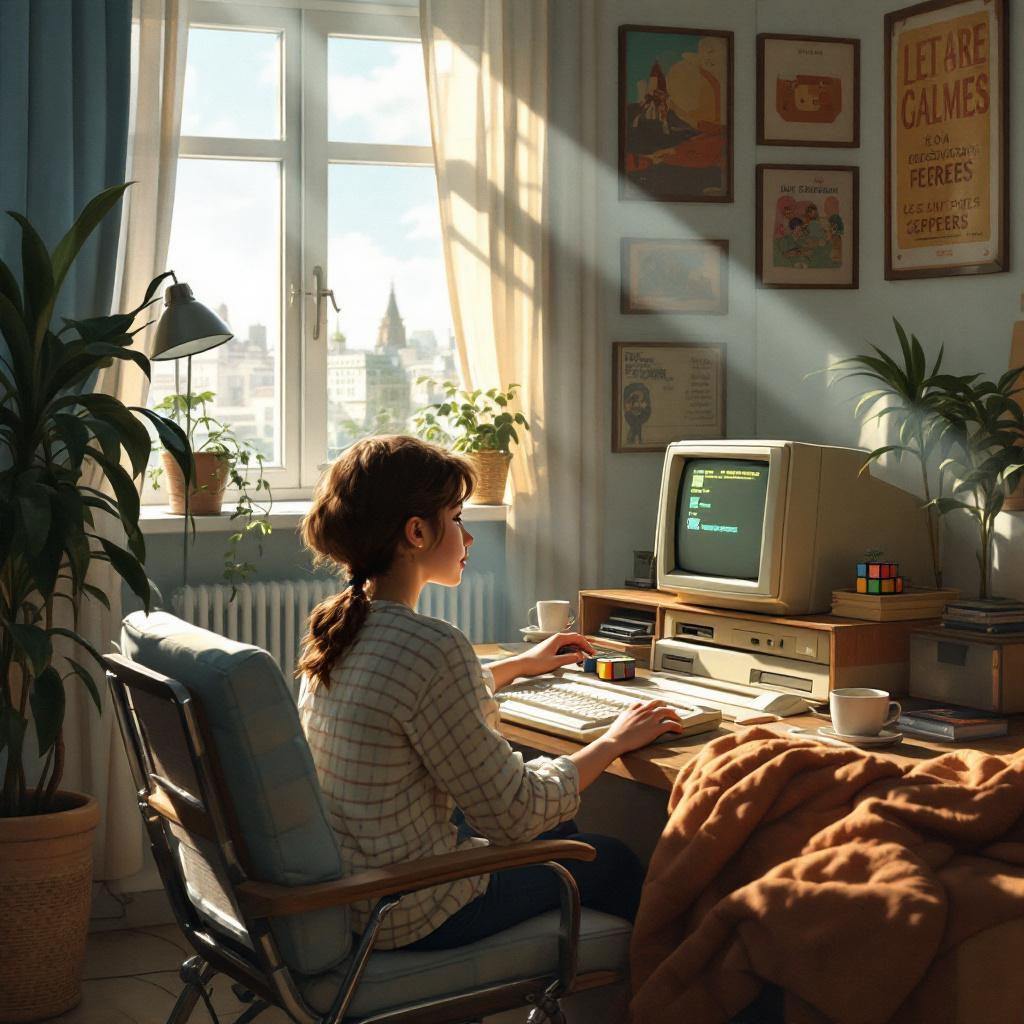
At the dawn of the 1980s, when the microcomputer landscape was experiencing a real boom, Thomson launched the TO5. The result of an ambitious national initiative, this model aimed to bring recreational computing closer to the general public, while integrating into educational programs. Far from being a mere gadget, the TO5 embodies the French attempt to compete with foreign giants by combining sober design, modular compatibility, and a growing software catalog.
Sommaire
In brief
🖥️ Thomson TO5: a microcomputer produced in over 100,000 units between 1983 and 1985, designed for learning and entertainment.
🎮 Equipped with a 6809E processor at 1 MHz, 48 KB of RAM, and modular connectivity, it supports cartridges and cassettes.
⚔️ Against the Atari 400/800 or Commodore 64, it relied on school partnerships and a game catalog adapted to the national market.
📚 Today, its memory lives on among collectors and enthusiasts of computer gaming history.
Genesis and ambitions of the Thomson TO5
In a France eager to strengthen its technological autonomy, Thomson was entrusted with the mission to provide machines that were both educational and entertaining. The TO5 succeeded the MO5 by multiplying options: cartridge port, cassette player, selection wheel, it aimed to be versatile. The idea was not just to sell a computer, but to establish a digital culture from primary school onwards. The result: a device distributed in many institutions, but also in specialized stores, at an attractive price.
Technical specifications
| Feature | Detail |
|---|---|
| Processor (CPU) | Motorola 6809E at 1 MHz |
| RAM | 48 KB (expandable via cartridge) |
| Graphics | 320×200 in 8 colors |
| Storage | Cassette player and cartridge port |
| Operating system | Thomson BASIC |
Design, interface, and ergonomics
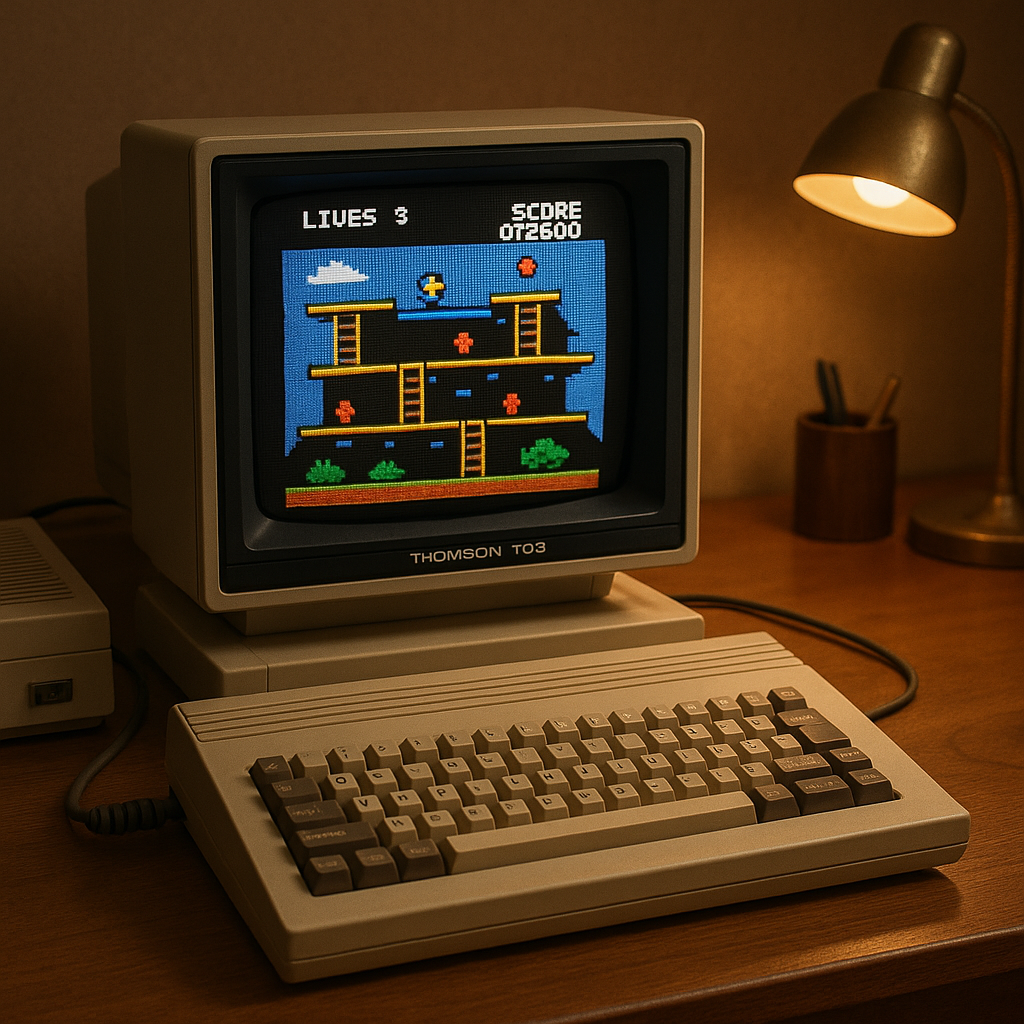
The TO5’s case reflects a very 80’s look: beige shell, square keys, and frame for an additional module. In use, the simplicity of connection is appreciated: a single SCART cable, a compact external power supply. The keyboard, although basic, offers satisfying tactile feedback and dedicated function keys for BASIC line editing. Strangely, it is this sobriety that gives it an almost timeless appearance, far from the bright colors offered by some competitors.
Game catalog and educational partnerships
Thomson developed, with various French studios, a game library mixing puzzles, simulations, and early shoot’em ups. The titles had little export, but the effort was notable: The Magic Labyrinth or Keyboard Pirates became local references. Like school programs, some educational software benefited from a ministerial label, guaranteeing content and pedagogy. Proof that the TO5 was not just an entertainment tool, but a catalyst for learning.
Competitors and Comparison
On the European market, the TO5 competes with the Atari 400, the Oric Atmos, and the famous Commodore 64. While each offers its own set of advantages (colors, sound, community), the TO5 stands out due to its institutional positioning and adaptability. This uniqueness sometimes leads it to join debates on the future of digital education. To better understand this evolution, one can dive into the chronology of gaming computers, where its role is placed in a global perspective.
Legacy and Impact in France
Beyond its commercial career, the TO5 leaves two lasting marks: on one hand, the familiarization of a generation with BASIC programming; on the other hand, the emerging enthusiasm for home computing. Several retro-computing associations have formed around this machine, organizing fairs and development contests. Even today, restoring a TO5 to working condition becomes a valued challenge, at the crossroads of electronic tinkering and video game history.
FAQ
What was the price of the Thomson TO5 at its release?
On average, it was sold around 3,500 francs, equivalent to 800 € today, depending on options and accessories.
Can cartridges and cassettes for the TO5 still be found?
Yes, through specialized shops and collectors’ markets. Some enthusiasts even produce new games for the platform.
Is the TO5 compatible with MO5 software?
Partially: most BASIC programs work, but the graphic modules specific to the MO5 require adaptations.
