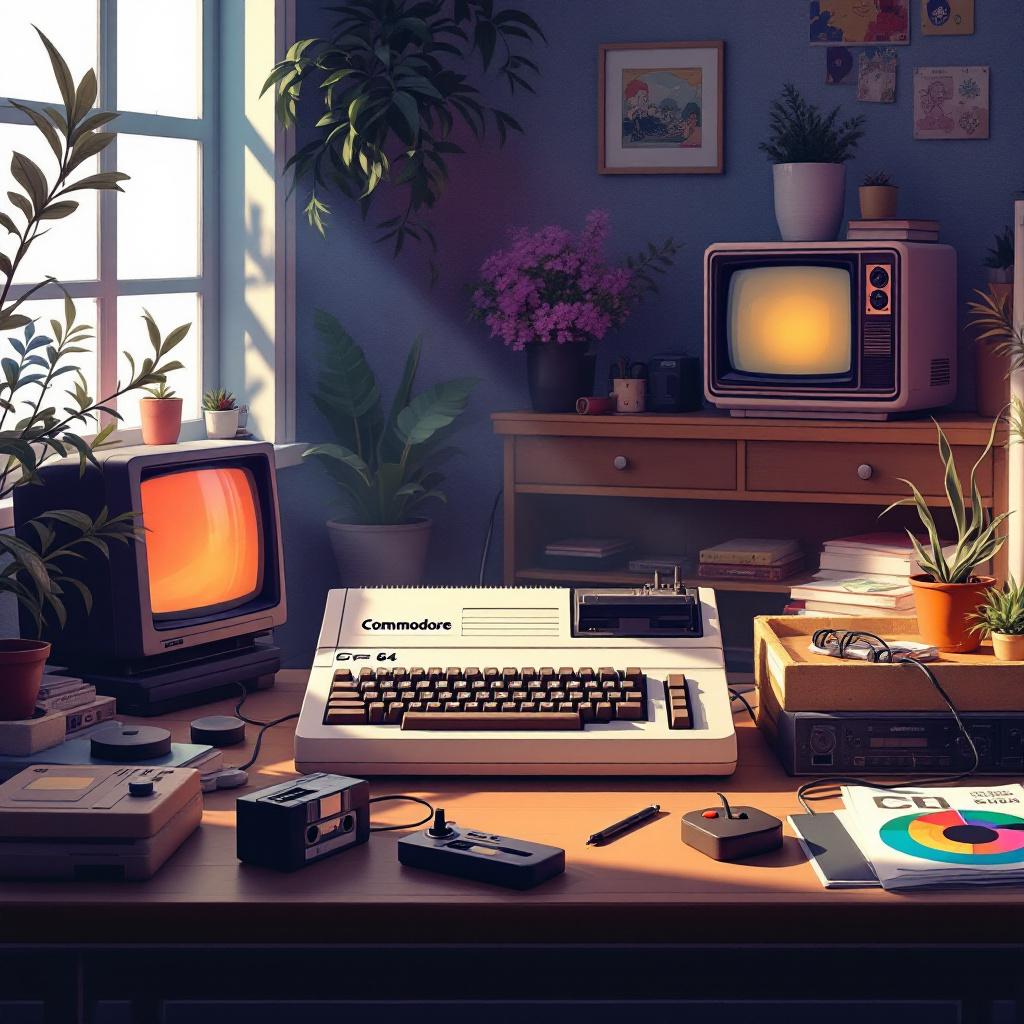
In the early 1980s, a revolutionary microcomputer conquered millions of homes and firmly established the idea that it was possible to play, learn, and create at home. The Commodore 64 — or C64 for insiders — is not only remarkable for its commercial success, it also brims with obscure features and manufacturing secrets that continue to amaze enthusiasts. Behind its unchanging design lie anecdotes worthy of the greatest electronic piracy novels.
🕹️ 8 – 17 MHz: the MOS 6510 processor, fixed at 1 MHz, can climb to over 10 MHz thanks to a simple timing hack, offering an unofficial boost for certain games.
🔊 The SID chip, mainly designed for sound, has had its modules compiled into modern synthesizers — proof that its analog amplifier is much more than a period gadget.
🎨 The VIC-II’s 16-color palette hides a “multi-shade” mode where sprites and backgrounds can be combined to create up to 1024 shades per screen refresh.
💾 More than just a player, the C64 was economical: its integrated modem (1650) already allowed data exchanges and Minitel access even before the Internet boom.
Sommaire
Diving into the historical context
When Jack Tramiel, founder of Commodore, launched the C64 in August 1982, he probably did not imagine sparking a cultural tidal wave. More than 17 million units were sold, a record placing it ahead of the Apple II or Atari 800. But to grasp the true impact of the C64, it must be placed in the chronology of gaming computers, between the early days of consumer microcomputers and the advent of modern gaming PCs.
10 little-known facts that make the legend
1. A chameleon-like CPU performance
One might think that the MOS 6510, clocked at 0.985 MHz, could barely run a BASIC interface. In reality, by subtly manipulating the registers of the VIC-II video chip, hackers managed to push its clock to over 10 MHz. This unofficial manipulation allowed smooth graphics rendering and faster calculations, sometimes at the cost of instability and significant heating.
2. The analog magic of the SID
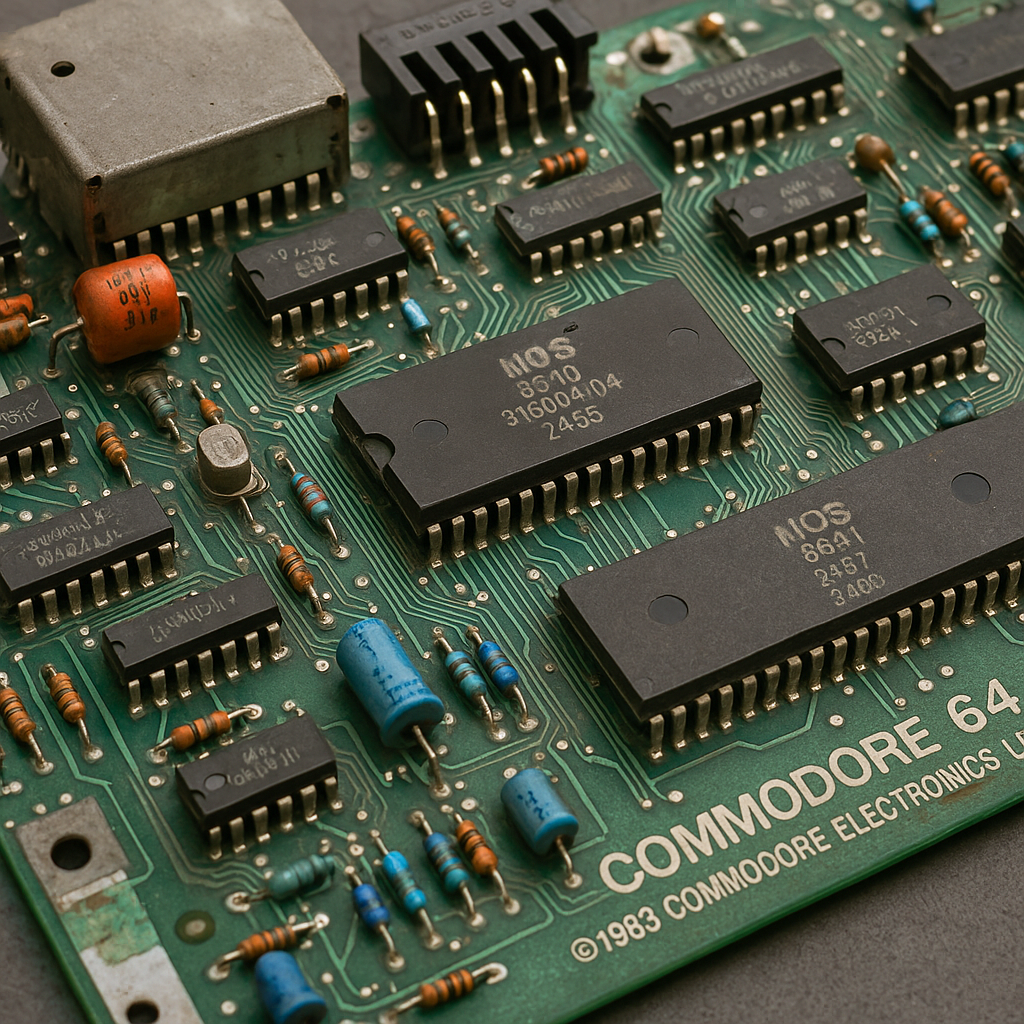
The sound heart of the C64, the SID 6581 chip, was not just a simple tone generator. Its ADSR envelopes, low-pass and high-pass filters — rare at the time — inspired an entire generation of electronic musicians. Even more astonishing, recent software versions incorporate faithful emulations down to the detail, ported as VSTs within digital audio workstations.
3. Hidden palette and optical illusion
The VIC-II officially offers 16 “standard” colors. Yet, by playing with the screen refresh frequency and multiplexing sprites, graphic artists took advantage of transparent areas to obtain more than 1,000 color variants. This is the trick used in some “demos” to simulate complex gradients long before the arrival of 256-color modes.
4. Beyond the game: the C64 in telematics
Before the Internet was synonymous with the World Wide Web, the Commodore offered a 1650 module in an external case, as compact as a telephone. Enthusiasts downloaded catalogs, amateur magazines, and programs via 300 baud connections. A “dial-up” version of the future, without modern visuals but filled with endless curiosity.
5. The anti-corrosion keyboard
Some first-generation C64s were fitted with an ABS plastic coating more fragile than PVC. Quickly, Commodore changed suppliers and equipped its models with a self-healing plastic, less sensitive to micro-scratches and corrosion caused by greasy fingers — a detail that explains the longevity of many second-hand keyboards.
6. Kevin’s Easter eggs
Kevin Savetz, a Commodore employee, integrated a secret message into the C64 BIOS accessible via a precise memory address. If one executed a small “POKE “address”, values”, it triggered a blinking pixelated owl, accompanied by the designers’ names. A discreet touch of humor in a still very serious universe.
7. Serial RAM expansion
Instead of limiting themselves to the external expansion port, some manufacturers developed cartridges that sequenced 512 KB or 1 MB modules, exploiting the internal bus. Result: drawing programs or word processors worthy of a professional microcomputer, while remaining under the 1000 franc mark of the time.
8. Pirated software in broad daylight
Unlike other systems, the C64 did not block direct access to the disk drive through its routines. Companies like Epyx or Synapse offered “fast copy” utilities: a simple graphical menu launched sector-by-sector duplication. Far from the complex protections of post-war CD-ROMs, but the result was ruthless.
9. Demo scene and impossible effects
At the turn of the 90s, European groups like Fairlight or The Black Lotus pushed the limits of the C64, orchestrating real-time “demos.” In particular, the “raster scroll” effect allowed color images to scroll on multiple planes, creating an almost 3D depth, without ever modifying the hardware.
10. An unprecedented longevity
The Commodore 64 was manufactured until 1994, 12 years after its launch. Like some Apple machines, it spanned three generations of compatible processors and several revisions of graphic chips. Even in 2023, there is an active community, between collectors and hobbyist programmers, perpetuating a unique digital heritage.
Comparison table: C64 vs competitors (1982)
| Model | Processor | Memory | Sound | Launch price |
|---|---|---|---|---|
| Commodore 64 | MOS 6510 @ 1 MHz | 64 KB | SID 6581 | $595 |
| Atari 800 | 6502 @ 1.79 MHz | 8–48 KB | POKEY | $999 |
| Apple IIe | 6502 @ 1 MHz | 64 KB | Mono speaker | $1398 |
FAQ
- Does the Commodore 64 still run on recent machines?
- Yes, thanks to emulators like VICE or Frodo, you can run most original programs on PC, Mac, or Linux, sometimes with advanced debugging options.
- What programming language was mainly used?
- BASIC 2.0 delivered in ROM was accessible at startup, but many developers switched to 6502 assembly to make the most of the VIC-II and SID chips.
- Can new cartridges still be found?
- Some micro-publishers produce games and utilities on cartridges, but production is limited and the price, often higher than the original, reflects the rarity of the component.
- What is the largest memory card ever created?
- An enthusiast even designed a 4 MB module in series, playing with bus multiplexing, but the practical interest remained more demonstrative than truly applicable.
