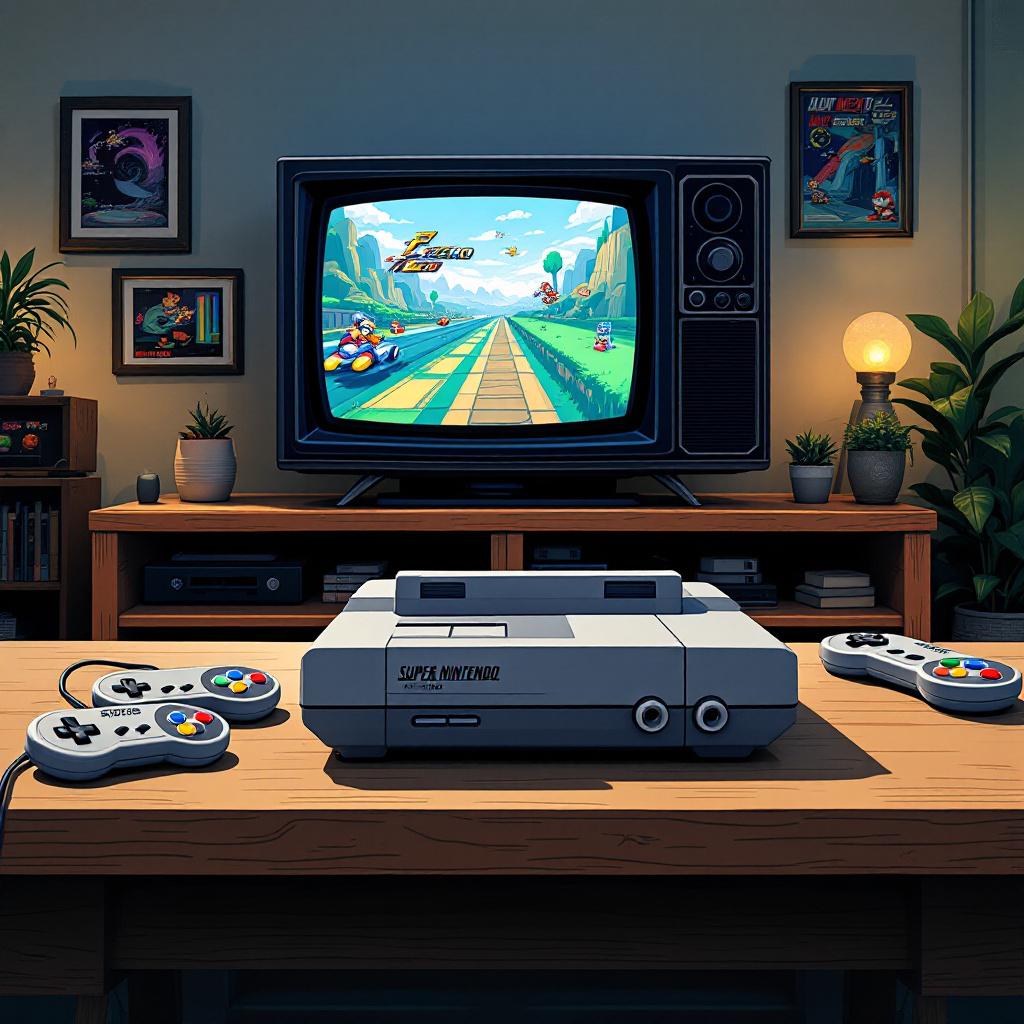
When the Super Nintendo arrived on the market in 1990 (1991 in Europe), it elevated 16-bit thanks to a clever balance between raw power and hardware creativity. More than just a console, the SNES offered a palette of games with unprecedented color richness and a little technological gem called Mode 7, capable of rotating, zooming, and deforming textures in real time on a plane. Today, it remains a reference for understanding the evolution of early 2D/3D gaming.
Sommaire
In brief
🔹 Iconic 16-bit launched in 1990, with a rich library of over 1700 titles ranging from RPGs to shoot ’em ups.
🚀 The Mode 7 transforms 2D planes into smooth pseudo-3D, paving the way for unprecedented racing and panoramic views.
💾 Under the hood: Ricoh 5A22 3.58 MHz processor, 128 KB main RAM, and cartridges from 4 Mb to 48 Mb depending on the games.
📚 For comparison, it competed with the Mega Drive, PC Engine, and even computers like the Amiga or Atari ST.
The origins of a 16-bit queen
At the end of the 1980s, Nintendo sought to surpass the success of the NES without falling into price escalation. The idea was to include a customized CPU (Ricoh 5A22) coupled with a Sony SPC700 sound processor, offering superior audio and visual quality. This duo allowed not only larger and more colorful sprites but also simple multitasking for music and sound effects, giving each title its own identity.
The controller design, with its two shoulder buttons and rounded ergonomics, immediately charmed. The bet was risky: to offer complex hardware while keeping the console accessible to the general public. The bet paid off, as in less than a year, the SNES established itself in homes as the most versatile 16-bit platform.
The SNES technical sheet
Key specifications
| Element | Details |
|---|---|
| Processor (CPU) | Ricoh 5A22 custom, 3.58 MHz |
| RAM | 128 KB |
| Video RAM (VRAM) | 64 KB |
| Audio | Sony SPC700, 64 channels, 32 kHz sampling |
| Media | Cartridges (4 Mb to 48 Mb) |
| Graphics | 8 backgrounds, 128 sprites, Mode 7 |
Mode 7: visual feat
Mode 7 is not a separate processor but a mapping technique that applies a transformation matrix on a 2D plane. The result: you can rotate, zoom, or tilt a background in real time, giving the illusion of a three-dimensional space. In races like F-Zero or Pilotwings, the sensation of speed and depth arises from this simple mathematical trick.
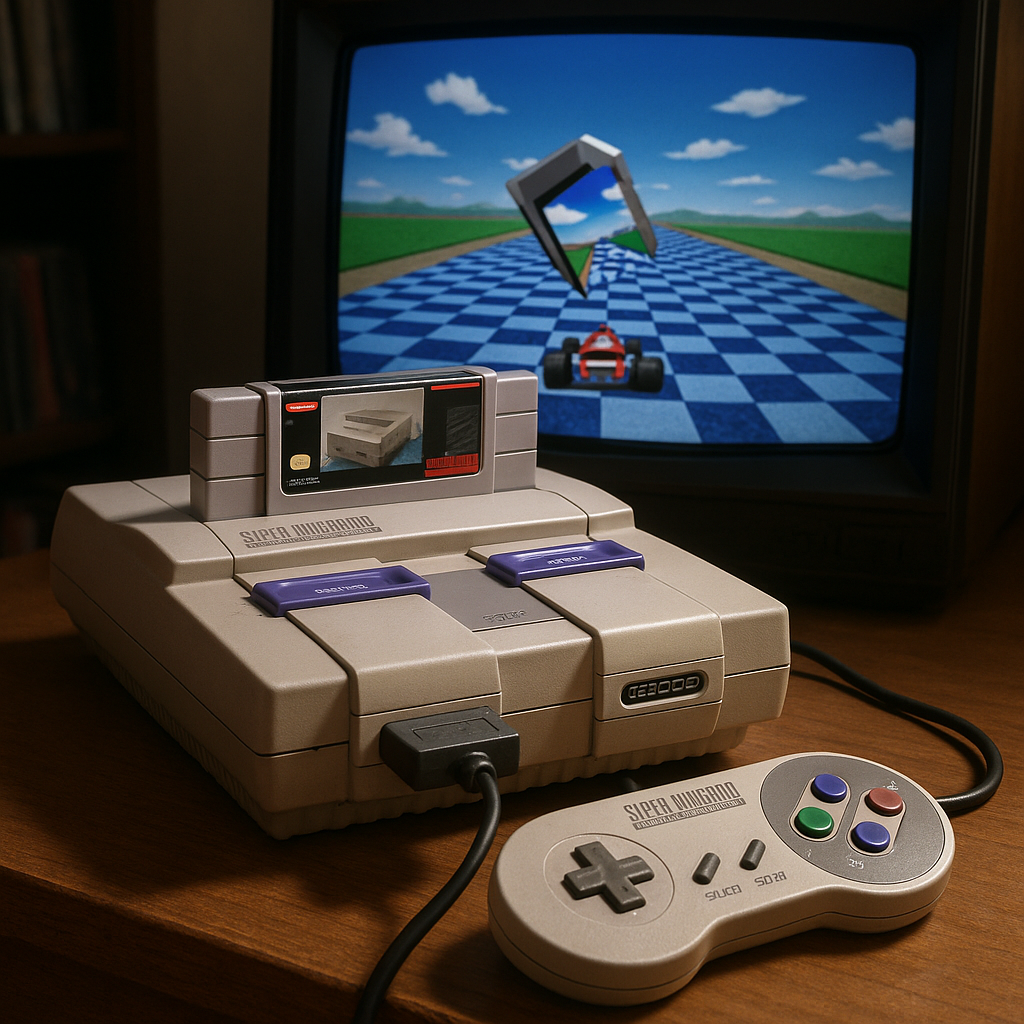
One might think Mode 7 is limited to rotation, but it was also used in platform titles to create unprecedented mirror or perspective effects. The flexibility offered inspired developers to push graphical limits while maintaining exemplary fluidity – it is undoubtedly this mix of inventiveness and performance that has engraved the SNES in memories.
Competition & alternatives: computers and rivals
On the same 16-bit segment, several machines competed:
- Sega Mega Drive: a 7.67 MHz processor and somewhat more limited colors, but a library of fast-paced games.
- PCEngine: slimmer, more expensive, and especially strong on shoot ’em ups, with compact HuCard cartridges.
- Amiga 500: with astonishing graphic performance for a computer, but without native controller support or true cartridge support.
- Atari ST: direct competitor to the Amiga, widely used in music production, but less optimized for pure gaming.
Each of these platforms offered particular strengths, but Nintendo played the card of overall balance: power, ergonomics, and renewal of the game library.
Legacy and posterity
Between 1990 and the late 1990s, the SNES consolidated the RPG universe with Chrono Trigger and Final Fantasy VI, and laid the foundations of the pixel-art boosted platformer genre. To better understand how it fits into the history of video game consoles, just place its influence within a lineage that began in 1972 and is still active today.
Mode 7 continues to inspire: its principles are found in modern shaders. And when you launch an emulator, it’s not just for nostalgia; it’s also to revisit an era where every chip was a field of experimentation.
FAQ
- What is Mode 7?
- A graphic mode that applies transformations (rotation, scaling) on a 2D background layer, to simulate a real-time 3D effect.
- How did the SNES compare to the Mega Drive?
- The Mega Drive relied on a faster CPU while the SNES offered a dedicated sound processor and more varied graphic effects, including Mode 7.
- Can Super Famicom games be used on a European SNES?
- Only a few adapters or hardware modifications allow these Japanese cartridges to work on PAL consoles.
- Which cartridges took the longest to load?
- Those equipped with additional chips like the SuperFX (used in Star Fox) for primitive polygonal rendering.
