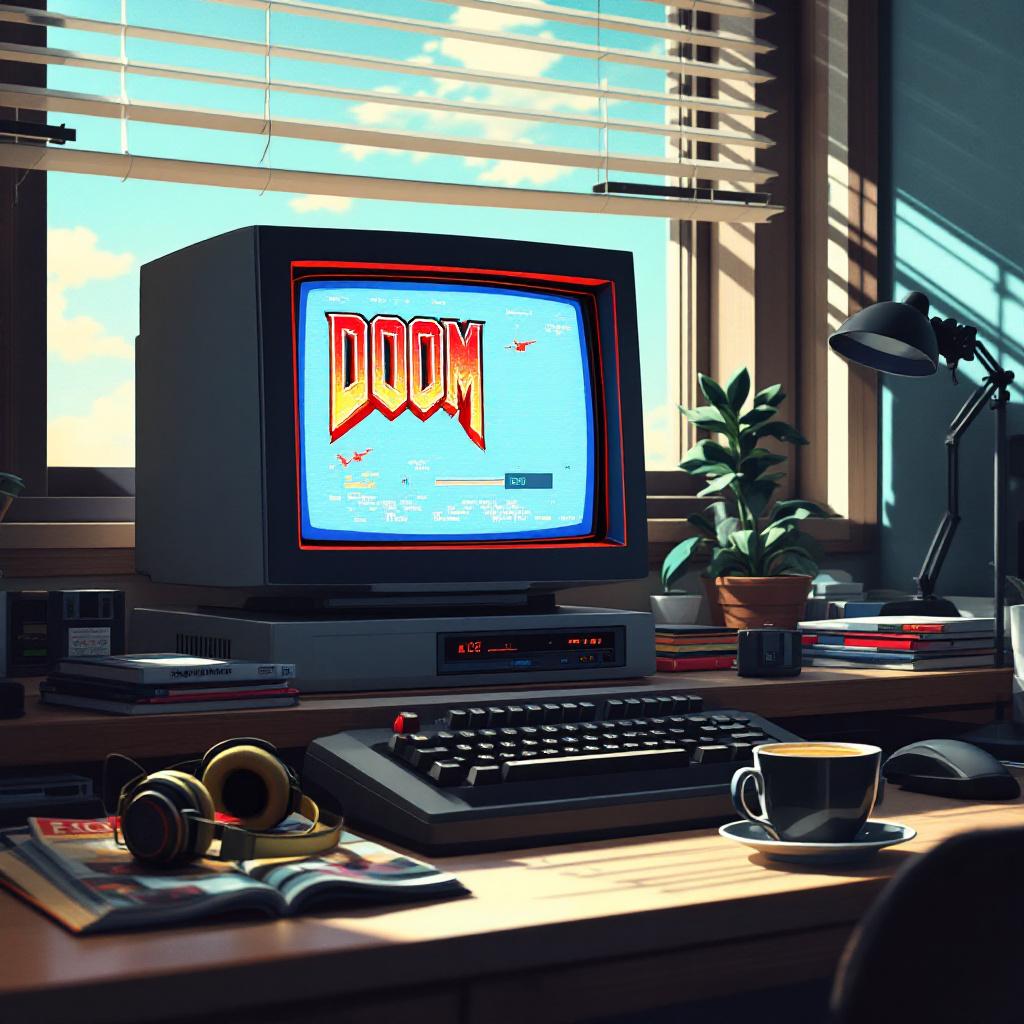
In the early 90s, software sharing was no longer confined to computer magazines and amateur clubs: Doom propelled the concept of shareware on DOS to another level. This is how id Software, by betting on the free distribution of the first episode, redefined the way players discovered and embraced a game.
Sommaire
In brief
🚀 Thanks to **Doom**, id Software popularized a distribution model where the **first episode** is offered for free, encouraging the purchase of the rest.
💾 Shareware on **DOS** utilized **floppy disks** and **bulletin boards** to bypass commercial networks.
🔥 This method greatly expanded Doom’s reach, turning students and enthusiasts into promoters.
📈 The legacy of this upheaval can be seen in the rise of online platforms and modern demos.
Historical context: the advent of shareware on DOS
During the reign of MS-DOS, game distribution often went through sealed boxes and traditional sales channels. However, the budget constraints of small studios pushed them to seek alternatives: shareware emerged as an ingenious compromise. A free excerpt was offered, long enough to intrigue, in exchange for which the user had to pay for the full version directly to the publisher.
Technical and commercial constraints
At the time, the capacity of a burned floppy disk was 1.44 MB. To make the game attractive without overflowing, every kilobyte counted. Developers worked hard to optimize graphics and sounds while calibrating the free portion. Commercially, there were no online stores: floppy disks were sent by mail or via BBS (Bulletin Board Systems). Far from today’s cloud services, each user became a vector of distribution.
Early experiments
Before Doom, some sharewares like Commander Keen had paved the way but without causing a tidal wave. These prototypes served as laboratories: they highlighted the risks of piracy, the postal logistics to manage, and the need for viral marketing—a term that did not yet exist but was felt.
DOOM: the catalyst of a new era
Released in December 1993, Doom crystallized all expectations. Ultra-fast, immersive, and compatible with most DOS PCs, it featured smooth netcode and rudimentary but impactful 3D. id Software bet on a first episode of 9 levels, distributed for free, followed by three paid episodes.
An unprecedented distribution strategy
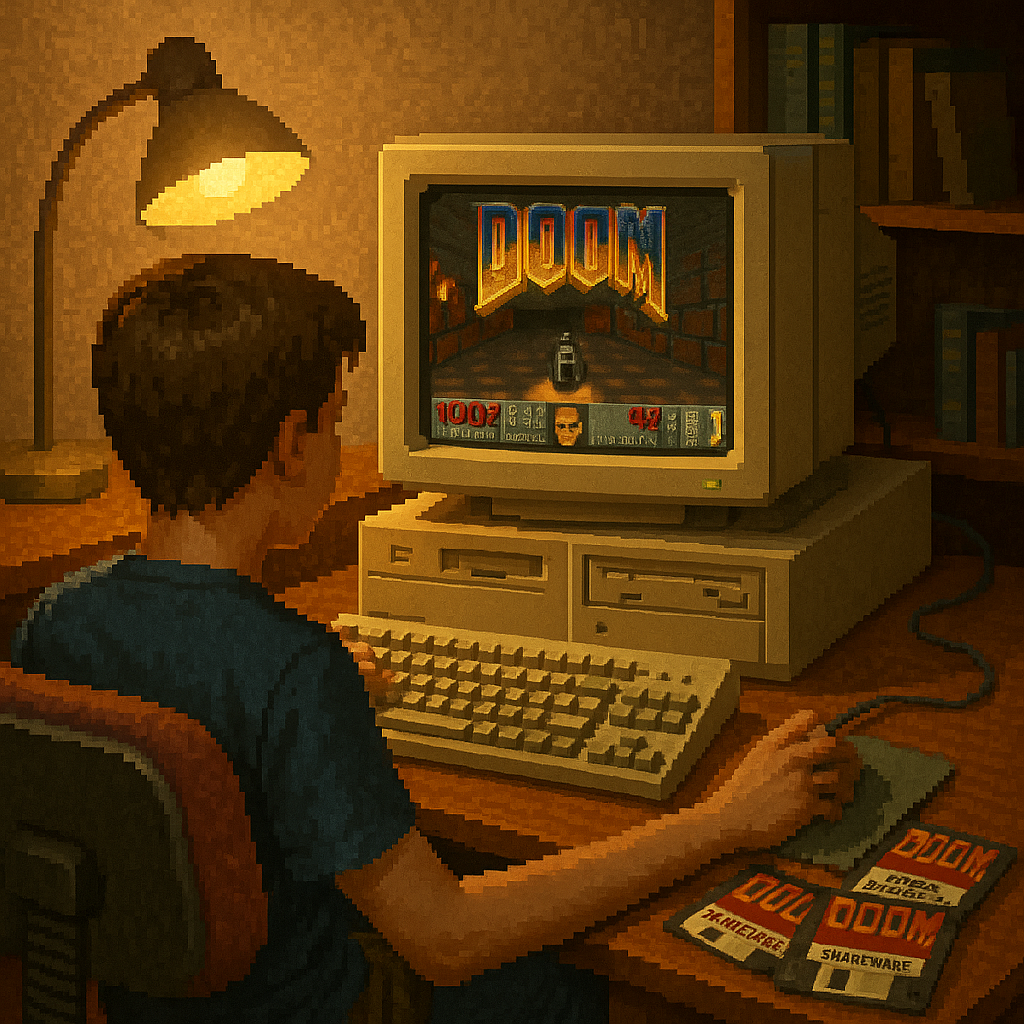
The “Doom shareware” copied and recopied itself endlessly. Each new user became an impromptu salesman. Some university networks hosted the files for free access, and very quickly, Doom was found on every floppy disk ready to run. This virality was unexpected: the demand for full versions exploded, and id Software earned enough revenue to finance itself without going through a major publisher.
Impact on the gaming industry
Doom not only popularized shareware, it inspired countless clones and sparked new creator vocations. The presence of a rudimentary multiplayer mode initiated the future of networking, while the modularity of the code allowed mods that extended the game’s longevity. In other words, id Software had invented a virtuous circle: free distribution, community enthusiasm, direct purchases, shared innovations.
Technical specifications of DOOM on DOS
| Element | Specification |
|---|---|
| Processor | 386 at 33 MHz (recommended: 486) |
| RAM | 4 MB minimum (8 MB recommended) |
| Storage | 10 MB free on hard drive |
| Media | 3 floppy disks 1.44 MB / CD-ROM in Deluxe version |
| System | MS-DOS 5.0 or higher |
Competing computers
Although MS-DOS dominated, other architectures competed for digital entertainment.
- Amiga 500: superior graphics, but few FPS titles.
- Atari ST: versatile in music, rarely adapted for 3D games.
- Apple II: at the end of its life, still popular in education.
- PC compatibles 286: often too slow for Doom, reserved for 2D games.
Legacy and transition to modern PCs
The Doom shareware model paved the way for today’s **demos** and **free-to-play** games. Online platforms adopt this logic of discovery before purchase. If you are interested in the genealogy of machines, this chronology of gaming computers reveals how modern gaming PCs have evolved from these pioneers.
“We knew that shareware was going to change the way players discovered games.” – John Romero
FAQ
What is shareware?
Shareware is a free software excerpt designed to be copied and distributed freely, with the option to purchase the full version.
Why did Doom choose this model?
Lacking a publisher willing to finance the project, id Software bet on word-of-mouth and the virality of sharing to generate a direct source of income.
How to get the full version of Doom today?
Several digital platforms offer the old episodes in retro collections or via official emulators.
