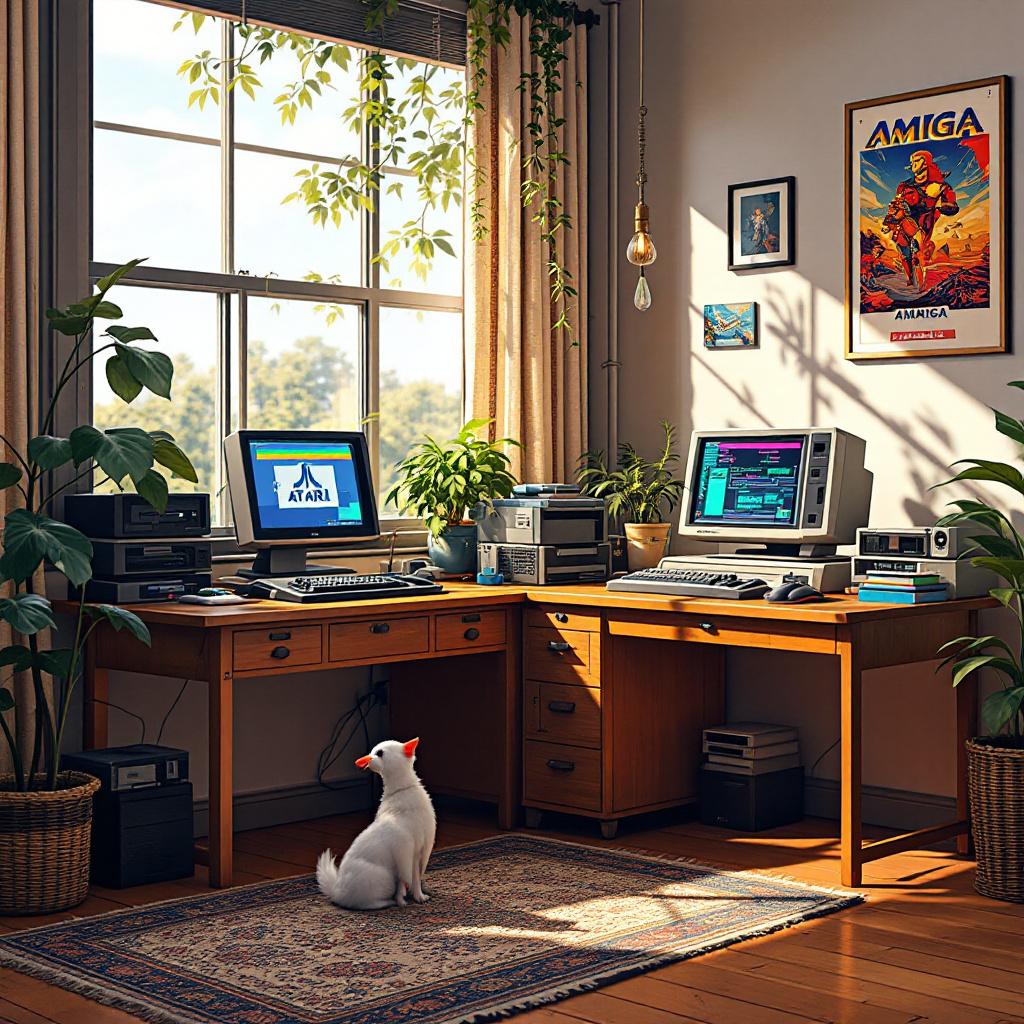
When discussing the golden age of 16-bit microcomputers, two names immediately come to mind: the Atari ST and the Commodore Amiga. At the end of the 1980s, these machines embodied the promise of a major technological leap, both for the general public and multimedia professionals. Yet, behind the commercial battle, there was also a war of architectures and ambitions: simple attractive price or a demonstration of graphical and sound power? This article explores in depth the strengths, weaknesses, and legacy of these two legends to determine which of the two microcomputers truly marked its era… and ours.
Sommaire
In brief
🔸 Atari ST vs Commodore Amiga: a top 16-bit duel around the same 8 MHz CPU frequency, but major divergences in graphics and sound.
🔸 The ST stands out with a solid integrated keyboard and an aggressive price, while the Amiga relies on its multi-chipset to offer superior animations and sound.
🔸 Beyond the technical sheet, it is the quality of games (MIDI tracking on ST, demos on Amiga) that sealed their reputation among gamers and creatives.
🔸 Their legacy is found today in the world of retro-gaming and in the sound and visual creation practices of independents.
Historical context of 16-bit micros
Following 8-bit machines like the ZX Spectrum and the Commodore 64, the emergence of 16-bit was initially synonymous with raw power and expanded graphic palettes. Atari and Commodore, already well established, felt the need to respond to the rise of the first compatible PCs. This clash heralded the rapid evolution of platforms, from the first microcomputers to modern gaming PCs, where 3D and 32-bit eventually supplanted the 16-bit generation.
Technical specifications
| Characteristic | Atari ST | Commodore Amiga |
|---|---|---|
| Processor | Motorola 68000 @ 8 MHz | Motorola 68000 @ 7.16 MHz |
| RAM | 512 KB to 4 MB | 512 KB to 1 MB (expandable) |
| Graphics | Monochrome or 4 colors @ 320×200 | 4096 color palette, modes up to 32 colors |
| Audio | 3 FM channels (YM2149) | 4 PCM channels + 3 ADSR channels |
| Storage | 3.5″ floppy disk 360 KB | 3.5″ floppy disk 880 KB or hard disk drive |
| Launch price | ~999 FF | ~1490 FF |
Design and ergonomics
Case and keyboard
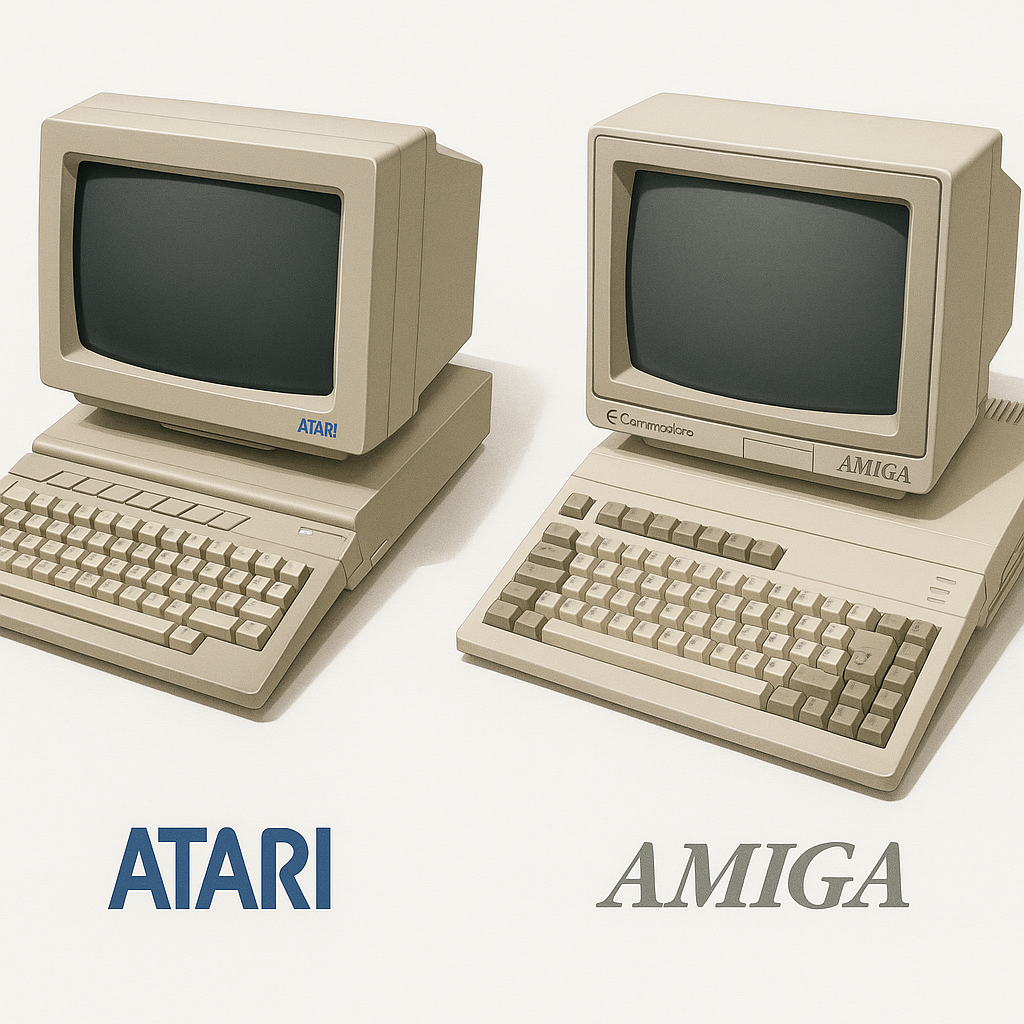
The Atari ST’s case, with its angular lines and integrated wrist rest, emphasized robustness. Its keyboard, often compared to that of an IBM PC, was appreciated by professional typists. The Amiga, more compact, had a more discreet wrist rest and a keyboard with a softer touch, sometimes considered too light for intensive office use.
User Interface
Atari offered TOS (The Operating System) and GEM, a graphical interface inspired by Macs. Simple, efficient, with rectangular icons. Commodore launched AmigaOS, a pioneer of preemptive multitasking: managing multiple applications in parallel without freezing the system was almost a feat at the time.
Technical Performance
Processor and Memory
On paper, the Atari ST’s 8 MHz 68000 slightly outpaced the Amiga, but memory management and disk access were faster on the Amiga thanks to its Direct Memory Access bus. In practice, some graphic and music applications preferred the ST’s lower latency while others exploited the Amiga’s DMA for more complex processing.
Graphics and Sound
“The real strength of the Amiga lay in its custom chips: Agnus, Denise, and Paula formed an ecosystem capable of managing sprites, scrolling, and audio multiplexing in real time.”
The Amiga’s graphics chipset offered sprite effects and smooth hardware scrolling, coupled with stereo PCM sound. The Atari ST, limited to three FM channels, compensated with a faster Hertzian bus, which gave it lower latency for music and explained its success in MIDI studios.
Game Catalog and Creativity
Key Genres
- Adventure games: point-and-click on ST, joystick legends on Amiga
- Demo scene: the Amiga was the favorite playground for coders thanks to its advanced display routines
- Simulations: ST favored for interface management, Amiga for immersive graphics
Notable Exclusives
On the ST, Dungeon Master and Speedball II made their mark, while the Amiga delivered Shadow of the Beast and the legendary Lemmings. Ultimately, each machine cultivated its own gaming identity and a loyal community.
The Verdict: Which Winner?
Choosing between Atari ST and Amiga often comes down to deciding between two philosophies: the ST bets on simplicity and raw speed, the Amiga on technical originality and multimedia rendering. Commercially, the Amiga flirted with 4 million units sold against the ST’s 6 million, but the gap narrows when considering professional variants (Mega ST, Amiga 1000). Today, it is less a question of numbers than preference: those who valued instrumental music will lean towards the ST, while fans of visual effects and demos will have eyes only for the Amiga.
FAQ
Was the Motorola 68000 really identical on both machines?
Technically, yes: the same 16/32-bit core. In practice, the frequency difference (8 MHz versus 7.16 MHz) and memory management noticeably distinguish their performances.
Which machine sold better in France?
The Atari ST had a faster start thanks to a lower entry price. Nevertheless, the Amiga caught up with PC bundles and packaged offers including double-density floppy drives.
Can we still play these classics today?
Between emulation, mini-consoles, and retro-tech communities, access is as simple as can be. ROM files and disk images circulate freely as long as one holds the legal rights.
