| Key Points | Details to Remember |
|---|---|
| 🕹️ Origins | 8-bit as the starting point of micro gaming |
| 🎨 Graphics | 16-bit and its role in visual evolution |
| 💾 Distribution | shareware DOS and direct access to players |
| 🎮 Standardization | Windows 95 and DirectX for a unified ecosystem |
| 🚀 Acceleration | 3D hardware with 3dfx, Nvidia, and ATI |
| 💻 Modernity | RTX, ray tracing, and portable platforms |
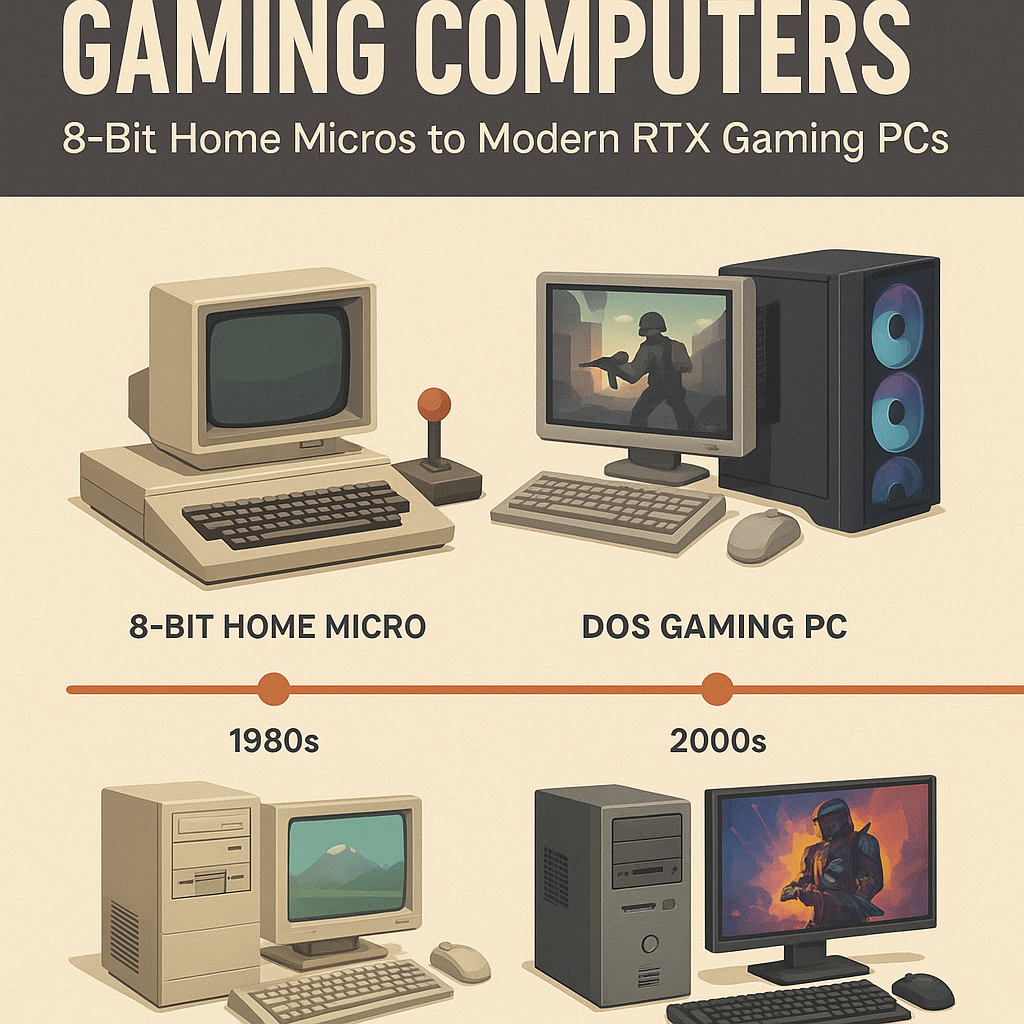
From the earliest microcomputers, enthusiasts perceived the gaming potential beyond simple lines of code. Memory limitations quickly turned into creative challenges, laying the foundation for what would become the history of gaming computers. From these modest machines to the graphic explosion of AAA franchises, each generation redefined the relationship between player and machine.
Sommaire
The 8-bit (ZX Spectrum, Commodore 64)
In the mid-1980s, the landscape was dominated by 8-bit processors often equipped with 48 to 64 KB of RAM. The ZX Spectrum attracted attention for its accessibility and a color palette which, despite artifacts, inspired genuine graphic feats. On the Western side, the Commodore 64 imposed its SID chip and joystick controller, becoming the reference machine for many amateur and professional studios.
In this context, the Oric Atmos proved that even outsiders could shake up the competition, sometimes offering unsuspected sound performances in a saturated market.
The 16-bit (Atari ST, Amiga)
Amiga and Atari ST, a silent war
With their 16-bit processors, the Amiga and Atari ST represented the pinnacle of innovation before the PC era. The multitasking of the former stood alongside the MIDI compatibility of the latter, creating a passionate duel. On some flagship titles, the Amiga 500 deployed impressive stereo sound and 32-color graphics, while the Atari ST 520 established itself as a tool for musical creation and a platform for legendary cracktros.
For those seeking an impartial assessment, the Atari ST vs Amiga showdown remains debated, as the difference sometimes comes down to just a few bytes.
MS-DOS and the Golden Age of Shareware (Doom, Duke 3D)
The arrival of IBM-compatible PCs, powered by IBM PC DOS then MS-DOS, opened the doors to digital distribution. Developers distributed their creations as DOS shareware, a revolutionary model that propelled Doom, Duke 3D, and Wolfenstein to worldwide success.
By exploring their command directory, any player could discover a new title every week, sometimes even before its official release.
Windows 95-98 and the Rise of DirectX
The transition to Windows 95 introduced DirectX, a set of APIs designed to simplify access to graphic and sound components. The flagship titles of the late decade benefited from a unified architecture, enabling lighting effects and animations previously reserved for consoles.
Developers, freed from low-level constraints, multiplied experiments in isometric 2D or early 3D, laying the groundwork for future blockbusters.
Accelerated 3D Transition (3dfx, Nvidia, ATI)
The late 1990s marked the emergence of accelerator cards: 3dfx’s Voodoo, ATI’s TNT, Nvidia’s Riva TNT. These chips offloaded part of the computation to the graphics card, easing the processor and allowing unprecedented refresh rates in 3D.
- 3dfx Voodoo: first convincing experience in three-dimensional textures.
- ATI Rage: support for real-time video.
- Nvidia Riva TNT: raw performance and polygon rendering.
Each generation pushed visualization towards greater realism, preparing the ground for shaders and ray tracing.
Standardization of PC Gaming (2000-2010)
From the Pentium III to the Core i7, consumer hardware became more professional. The 2000s PC gaming was equipped with motherboards featuring dedicated chipsets, DDR memory sticks, and gradually adopted modular power supplies.
A true ecosystem emerged: technical forums, specialized online stores, and the first full tower cases designed to optimize airflow.
Modern PC: RTX, Ray Tracing, Steam Deck
Today, the standard relies on Nvidia’s RTX or AMD’s RDNA architectures, capable of real-time ray tracing calculations. Configurations integrate AI for assisted rendering, DLSS or FSR, while portable platforms like the Steam Deck demonstrate that gaming PCs now come in a portable format.
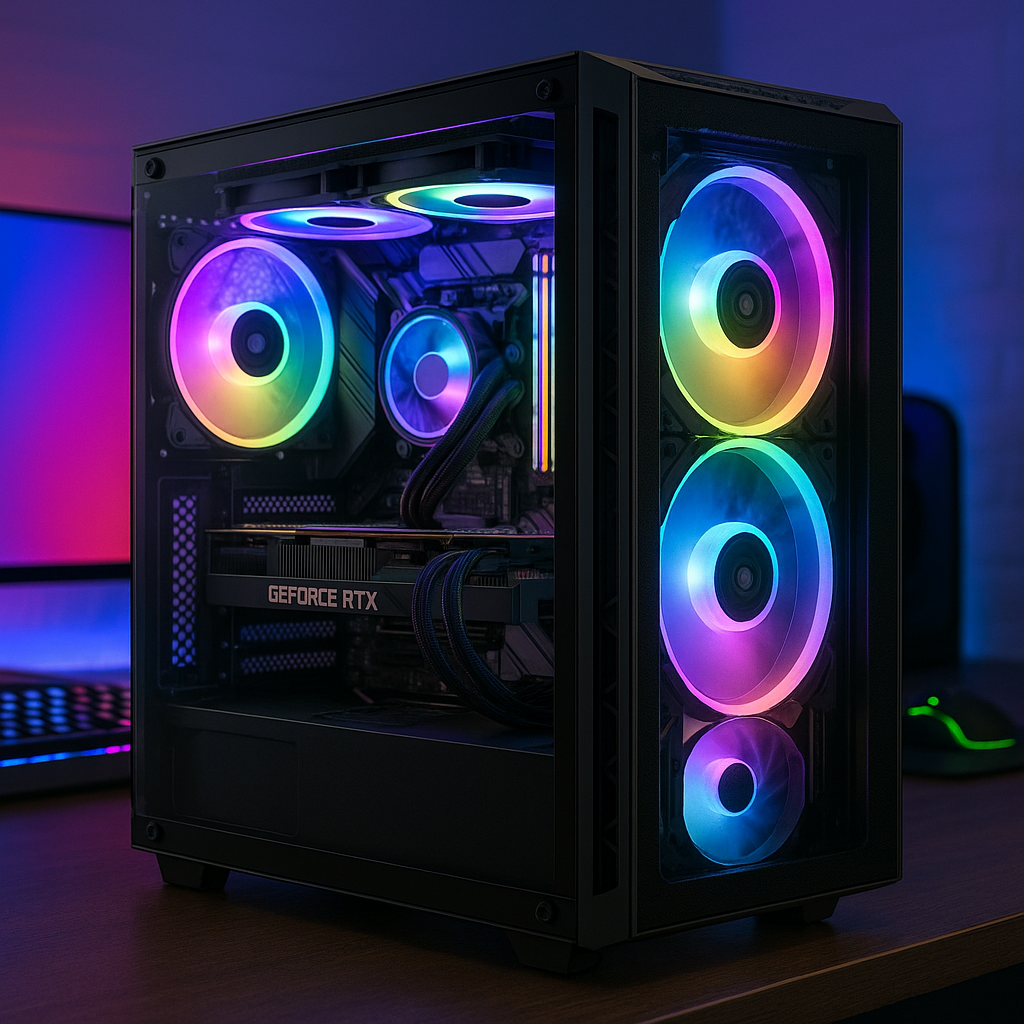
Power has tripled in ten years, but the philosophy remains familiar: to offer the player an immersive visual experience and smooth framerate, in a machine that continually pushes its own limits.
Conclusion
Tracing this journey, we see that each microprocessor laid a stone for the edifice of computer gaming. Whether it was demultiplexing a sound chip or optimizing a shader, the common thread remains the same: the quest for an ever more immersive experience. Today, nostalgia around 8-bit and 16-bit architectures fuels a genuine revival market, while the next generation promises new innovations.
Frequently Asked Questions
- Why did 8-bit computers make a mark on video gaming?
- Their low cost and accessible development kits allowed many enthusiasts to code and share games, launching the homebrew scene.
- What really differentiates Amiga and Atari ST?
- The Amiga achieved audio-graphic feats thanks to its coprocessors, while the Atari ST focused on MIDI and access for musicians and studios.
- How did DOS shareware transform distribution?
- It removed intermediaries, allowing developers to freely distribute a limited version and monetize updates.
- How did DirectX change the game on Windows?
- It provided a standardized interface to utilize graphics cards and sound cards, facilitating the development of multiplatform titles.
- What advances does ray tracing bring today?
- It simulates the real behavior of light for shadows, reflections, and refractions with unprecedented realism, at the expense of raw power.
