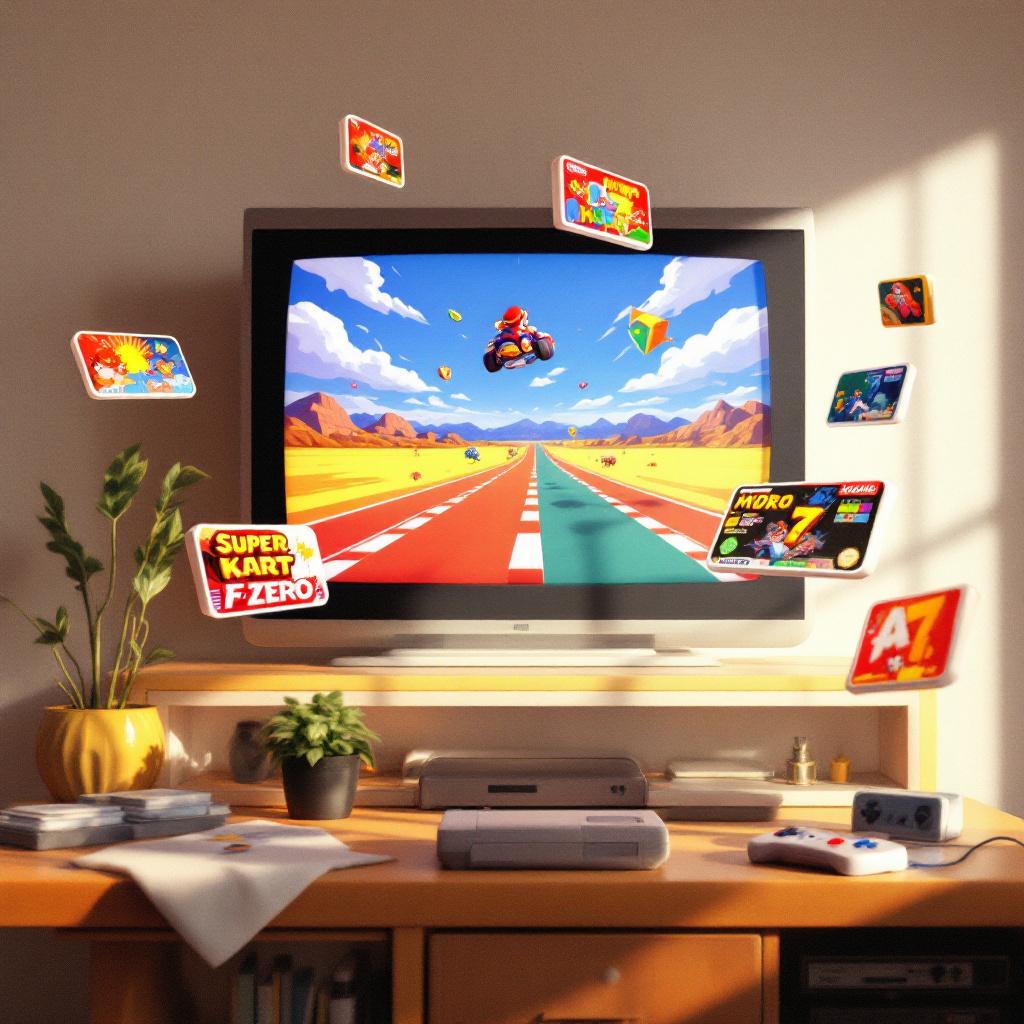
Mode 7 transformed the Super Nintendo into the queen of pseudo-3D, offering as early as 1990 rotating and scaled environments previously reserved for technology labs. Behind this feat, a chip specifically designed by Nintendo influenced an entire branch of game design, from F-Zero tracks to the skies of Pilotwings. This article dissects its operation, places this magic in the context of competing computers, and lists the essential titles that exploited this micro-graphic engine.
Sommaire
In brief
🙂 Mode 7: a unique background layer is rotated and scaled in real time to create an illusion of depth.
🚀 Dedicated SNES graphics chip, Mode 7 offered a near-3D rendering at the heart of a 16-bit console.
🎮 Key games: F-Zero, Super Mario Kart, and Pilotwings built their gameplay around this technique.
⚔️ Competition: on Amiga or PC VGA, rotation and scaling often depended on the CPU or third-party extensions, without the comfort of native hardware acceleration.
Origin and principles of Mode 7
An innovation signed Nintendo
At the end of the 1980s, Nintendo sought to equip its console with an unprecedented graphical dimension. The idea was to add to the main chip a secondary processor dedicated to rotation and scaling effects of a background layer. Rather than simulating 3D through heavy calculations, it plays on the deformation of a single tile map, turning each game into a perspective journey. This architecture earned Mode 7 the status of one of the iconic video game technologies in its own right.
Technical mechanism: rotation and scale
Concretely, Mode 7 takes a two-dimensional plane (512×512 pixels), which it rotates around its center and enlarges or reduces according to the simulated distance. Calculations are done in fixed-point, freeing the main Game CPU from heavy graphic tasks. This allows for a moving horizon at 60 frames per second, or rapid zooms without framerate drops. In practice, the game writes a new starting point (X,Y) for each line of the screen, creating the illusion of a ground unfolding beneath your wheels.
Architecture and technical specifications
Key components
The Super Nintendo is based on a Ricoh 5A22 CPU clocked at 3.58 MHz, accompanied by the RP2C07 graphics chip (Mode 7). The 64 KB video memory hosts several layers, including the one dedicated to Mode 7, while 128 KB of Work RAM serve calculations and sprites. This configuration seems modest compared to modern architectures, but at the time, it was enough to deliver a near-3D rendering in your living room.
Technical specifications
| Element | Specification |
|---|---|
| Main CPU | Ricoh 5A22 @ 3.58 MHz |
| Mode 7 chip | RP2C07, 2D rotation and scaling |
| Work RAM | 128 KB |
| Video RAM | 64 KB (4 layers, including Mode 7) |
| Resolution | 256×224 to 512×448 pixels |
| Media | SNES cartridges (up to 4 MB) |
PC and Personal Computers of the Era
The Amiga 500 and Atari ST had blitters capable of quickly copying memory blocks, ensuring smooth scrolling, but without native rotation. On PC, VGA offered 256 colors but the extent of 3D relied on the Intel 286/386 CPU: a compromise often considered too slow for dynamic effects beyond 320×200 pixels. Facing this “software” competition, the SNES fully played its hardware acceleration card, offering a rendering quality until then reserved for arcade machines.
Essential Games Exploiting Mode 7
Steer Your Destiny: F-Zero and Super Mario Kart
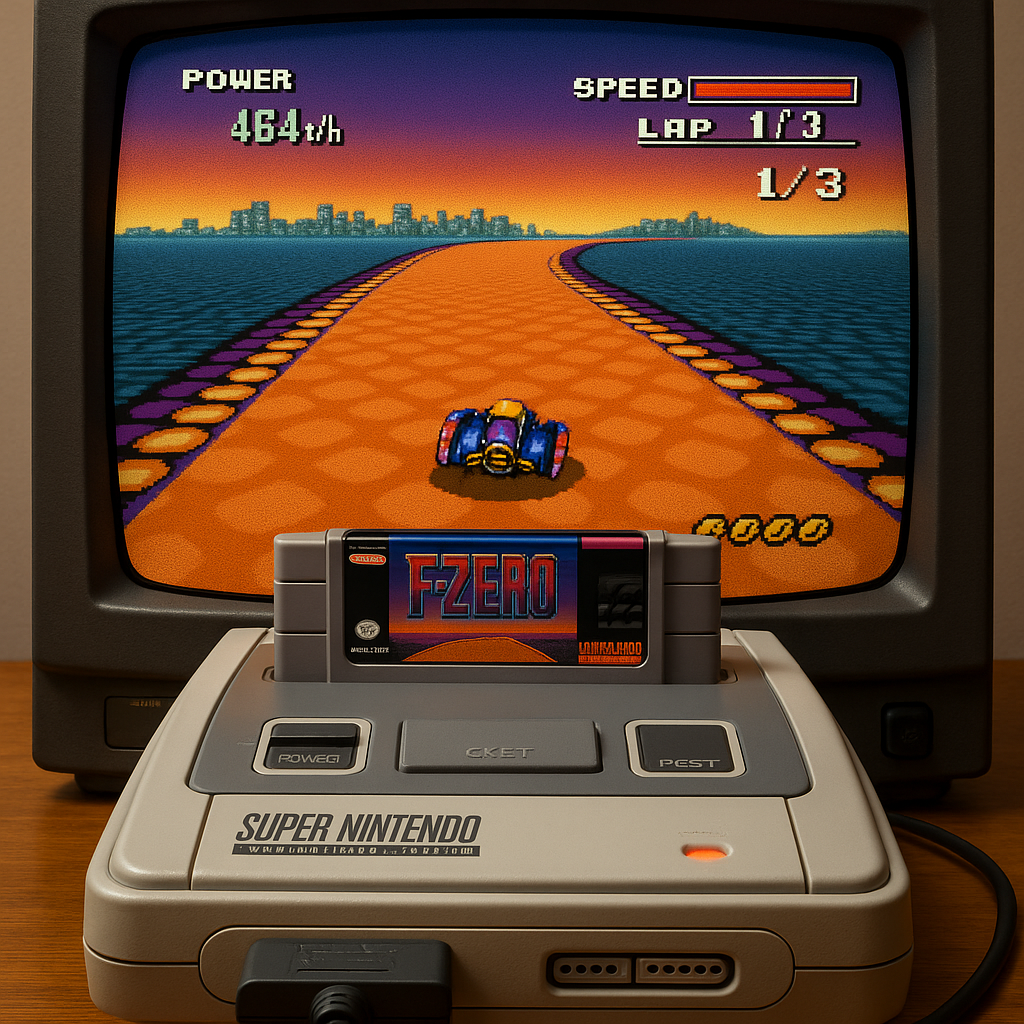
Released in 1990, F-Zero made a mark with its futuristic pseudo-3D tracks, zoomed and tilted thanks to Mode 7. Every turn takes on a spectacular dimension, enhanced by a flawless frame rate. A few years later, Super Mario Kart took the recipe and added items and a multiplayer dimension, popularizing perspective racing and inspiring 30 years of spin-offs.
Journeys and Adventures: Pilotwings and Beyond Oasis
Pilotwings offers a series of aerial challenges by combining sprites and Mode 7 backgrounds, simulating hang gliding or light aircraft flight. The depth effect is striking, with each landing requiring precise perspective calculation. Less known, Beyond Oasis subtly uses zoom and rotation for its dungeon rooms, offering a more immersive exploration sensation than simple scrolling.
Other Notable Examples
- Star Fox (Super FX vs Mode 7): a chip duel for 3D.
- ActRaiser: isometric city and 2D battlefields.
- Uniracers: moving landscape thumbnail as track background.
Limits and Legacy of Mode 7
Technical Restrictions and Workarounds
Mode 7 manages only one layer at a time, without occlusion or true perspective across multiple planes. To enrich the display, developers overlaid sprites and additional layers or divided the scene into zones managed classically. Some titles even create the illusion of walls or obstacles by combining Mode 7 and CPU math.
Influence on Real-Time 3D and Modern GPUs
At its core, Mode 7 foreshadowed the idea of “hardware transform & lighting” (T&L) ahead of its time. The concept of delegating geometric operations to a specific chip is found today in our GPUs with dedicated shaders and matrix calculation units. Without this precursor, real-time 3D likely would not have exploded so rapidly in home consoles.
FAQ
What is Mode 7 on the Super Nintendo?
Mode 7 is a graphic process that allows rotating and resizing a background layer to create an illusion of depth and pseudo-3D perspective.
How does Mode 7 work technically?
It relies on a dedicated chip (RP2C07) that performs fixed-point calculations of rotation and scaling for each display line, offloading the main CPU.
What are the most emblematic games using Mode 7?
The must-plays are F-Zero, Super Mario Kart, Pilotwings, but also ActRaiser, Beyond Oasis, or Uniracers.
Does Mode 7 have equivalents on other platforms?
On Amiga and PC, blitters or software libraries offered rotation/scaling effects, but without the native hardware acceleration of the SNES.
