
In 1986, Apple unveiled the IIGS, a machine with a dual ambition: to satisfy the compatibility of the legendary Apple II while initiating the transition to the Macintosh era. Less explored than its predecessors, this “GS” (Graphics & Sound) version is nonetheless a decisive milestone for the world of microcomputer video games. From its hardware innovations to its software ecosystem, the Apple IIGS deserves a revisit to understand how this system paved the way for modern PC gaming.
🎯 16-bit Graphics: the IIGS takes a visual leap with a palette of 4,096 colors, propelling games towards greater detail and depth.
⚡ Increased Power: 65C816 processor at 2.8 MHz, extended architecture, Apple II compatibility, and up to 1 MB of RAM for demanding titles.
🎵 Ensoniq Sound Chip: enriched sound synthesis, support for multiple simultaneous voices, immersive atmosphere far beyond classic beeps.
🕹️ Hybrid Library: a mix of Apple II games and exclusive titles, giving rise to hits now cult favorites among retro gaming enthusiasts.
Sommaire
Context and Genesis of the Apple IIGS
After the triumph of the Apple II starting in 1977, Apple wanted to respond to criticisms pointing to the aging of its range. The Macintosh, launched in 1984, focused on the graphical interface but struggled to convince microcomputer gaming enthusiasts. In this pivotal period, the IIGS was designed as a compromise: to offer Apple II users a more modern system while gently initiating the graphical and sound ecosystem of the Macs.
The Challenges to Overcome
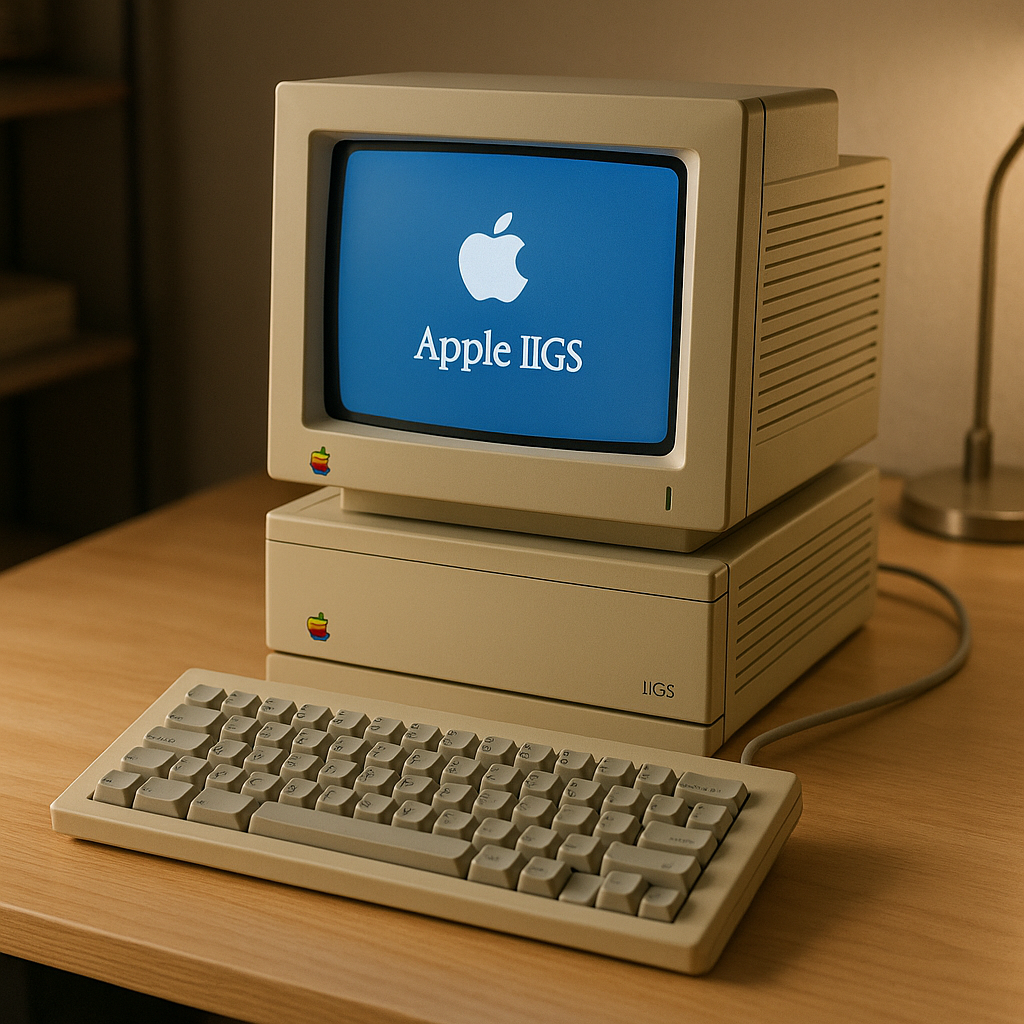
Apple had to preserve software compatibility with thousands of existing programs while introducing technical innovations. The company thus reworked its famous 6502 microprocessor, creating the 65C816 capable of addressing more memory and managing interrupts more efficiently. In terms of design, the gray case articulated a look that moved away from beige boxes to approach the first Macs.
Hardware Advances
The Apple IIGS is not just a simple refresh: it is a technological leap that positions the machine halfway between a home microcomputer and a playful workstation. Here are its key features:
| Component | Description |
|---|---|
| Processor | WDC 65C816 at 2.8 MHz (expandable via overclocking to 3.6 MHz) |
| RAM | 256 KB onboard, expandable up to 1 MB via additional modules |
| Graphics | Super Hi-Res Mode: 320×200 (4,096 colors) and 640×200 (256 colors) |
| Sound | Ensoniq ES5503 chip: 2 digital channels + 8 wavetable channels |
| Ports | Two joysticks, mouse, 3.5″ floppy drive, expansion slots |
It is enough to compare these elements to an Apple IIe to measure the progress: the latter was limited to 48 KB of RAM, a palette of 16 colors, and a simple sound circuit. The IIGS thus asserts itself as a true mini-Mac for gaming, despite its ROM system modeled on the 8-bit architecture.
An Open Design
Beyond the power, Apple’s philosophy was to open the IIGS to tinkerers and independent developers. Several expansion slots allowed adding accelerator cards, SCSI controllers, or even rudimentary network adapters. This flexibility fostered the emergence of accessories dedicated to gamers, from analog joysticks to third-party sound cards competing with the Ensoniq chip.
A Hybrid Software Ecosystem
The strength of the IIGS lies in its ability to run classic Apple II programs while benefiting from applications and games specifically designed for its graphical and sound capabilities. Publishers were thus able to deploy enhanced titles: colorful interactive adventures, more detailed shoot’em ups, finer simulations…
- Dark Castle (1987): a gothic platform game taking advantage of the Super Hi-Res mode.
- Ultima V (GS) (1988): revamped version with smoother animation and orchestral music via Ensoniq.
- Princess Tomato in the Salad Kingdom (1987): illustration of the narrative creativity enabled by the IIGS.
This diversity of titles partly explains the rise of retrogaming around the IIGS. Today’s enthusiasts still exchange restored copies and open-source adaptations, recreating the authentic experience on emulators. For those interested in the timeline of gaming computers, the IIGS holds a pivotal place between the first home machines and the explosion of PC gaming.
Impact on the Future of Apple Machines
Some consider the IIGS as the ultimate Apple II, others see it as a Mac ahead of its time. In reality, the lessons learned—extended color screen, advanced sound synthesis, smart software compatibility—fed Apple’s thinking for its subsequent models, notably the Macintosh II and the “LC” series. The concept of modular expansion cards and a high-performance graphics bus would later be found in the NuBus architecture of Macs.
“The IIGS was our testbed for multimedia interactions, long before marketing officially spoke of ‘power Macintosh’.” – internal statement from an Apple engineer (1989)
In short, the IIGS served as a living laboratory to test sound and graphic components, proving that a personal microcomputer could compete with consoles as long as it was provided with the right memory and chipset.
In Brief
For enthusiasts of video game history and vintage hardware, the Apple IIGS embodies a turning point: it combines the legendary reliability of the Apple II and the technological avant-garde of the early Macs. Thanks to its Ensoniq chip, an extended color palette, and remarkable software compatibility, it offered gamers of the time a preview of modern gaming.
Today, collectors scramble to recreate the authentic atmosphere of the 80s and early 90s, while curious collectors study its architecture as a precursor to multimedia computing. This “missing link” therefore fully deserves its place in computing legend.
FAQ
1. What are the major differences between the Apple IIe and Apple IIGS?
The IIGS offers a faster processor, expandable memory up to 1 MB, a 16-bit graphics mode, and an Ensoniq chip for sound synthesis, features that the Apple IIe could not achieve.
2. Can everything that runs on an Apple II run on an IIGS?
Yes: the IIGS remains backward compatible with almost all Apple II software, although some very specific hardware routines may cause problems.
3. How to save games on the IIGS today?
Enthusiasts use USB-to-floppy adapters or emulators offering virtual mounting of disk images. Some even make “Floppy Emu,” a peripheral that simulates a 5.25″ drive directly on the floppy port.
4. Where to find titles exclusive to the IIGS?
Online archives and retro gaming communities offer disk images for download. There are also restored editions sold with licenses by enthusiasts.
