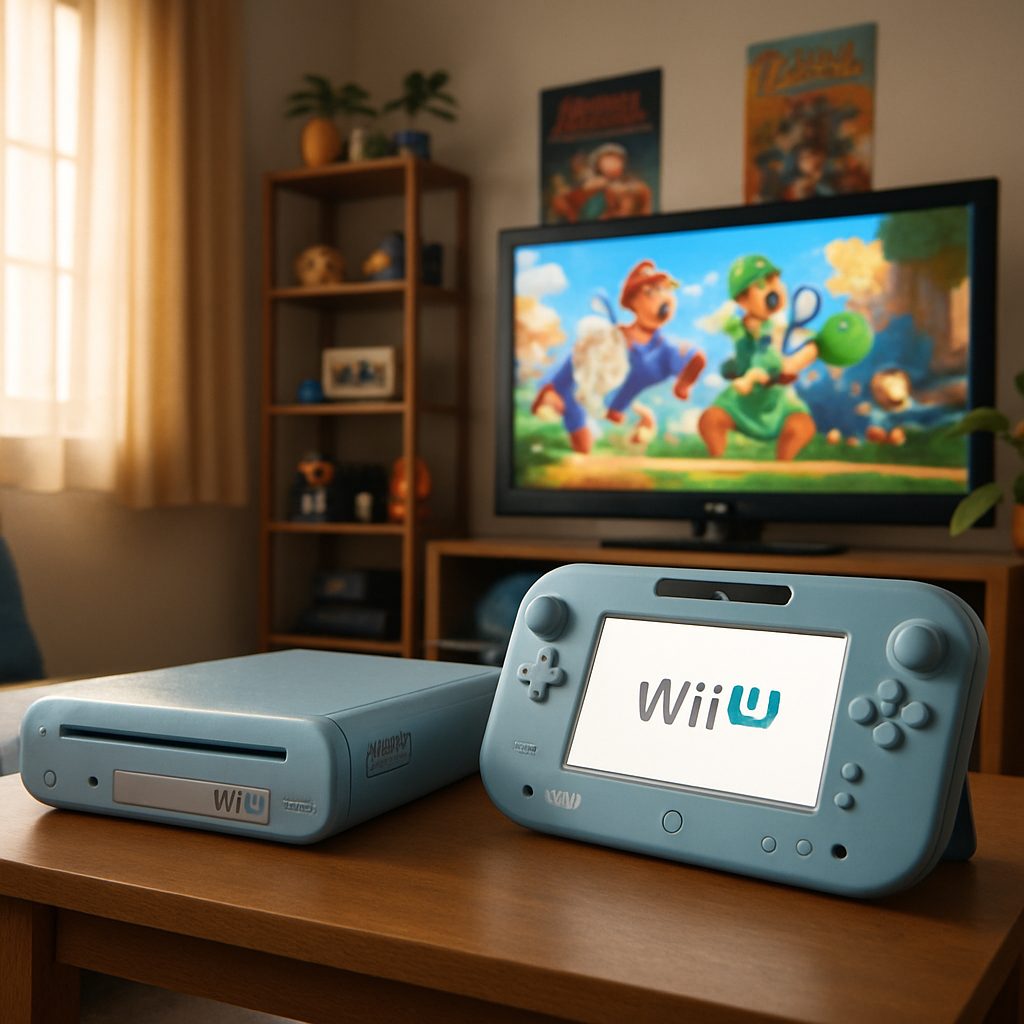
Upon its arrival at the end of 2012, the Wii U sparked as much curiosity as misunderstanding. With its GamePad at the heart of the system, Nintendo introduced a concept of hybridization between living room and portable gaming. However, confusing communication and visual similarities with the previous generation Wii hindered public acceptance. Let’s revisit the reasons for this relative failure, while highlighting the technical innovations and the decisive influence of this console on the Switch.
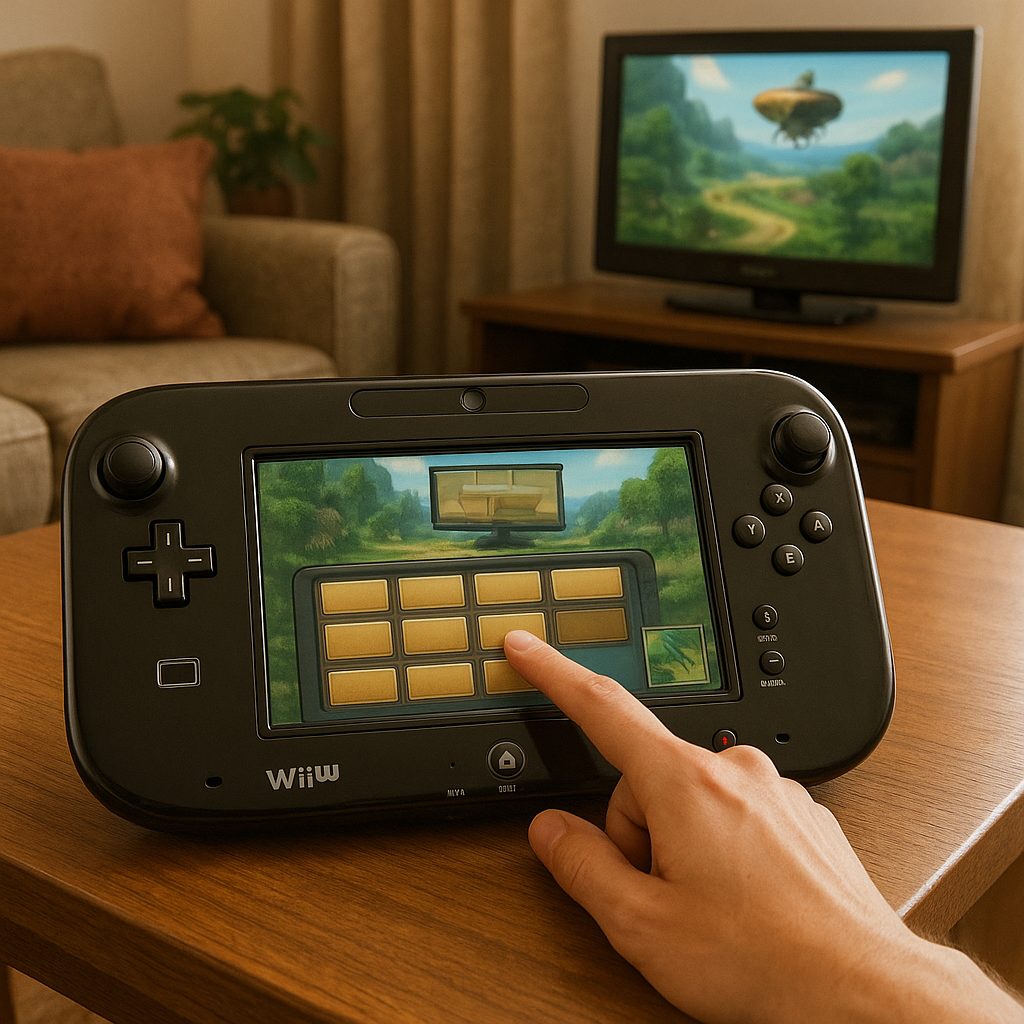
🕹️ Innovation: the Wii U introduces for the first time a remote touchscreen (the GamePad) allowing play without a television.
⚙️ Architecture: multi-core processor and 2 GB of RAM, a modest base compared to competing PCs and tablets, poorly marketed to the general public.
🎮 Game library: classic Nintendo combos (Mario, Zelda, Smash Bros.) and some unique experiences that did not find their audience.
🔄 Legacy: the concept of remote screen and hybrid mechanics paved the way for the Nintendo Switch, more harmonious in its approach.
Sommaire
Genesis of an unprecedented hybrid console
Nintendo’s ambitions
In 2010, the Kyoto giant was looking for the successor to the Wii, whose global success was due as much to accessible gameplay as to the renewal of its category. Rather than aiming for raw power, the idea was to rethink interaction by shifting part of the gameplay onto a tablet intended for the living room. This direction was justified by the desire to offer a native dual screen, to provide “off-TV play,” and to stimulate new forms of local cooperation.
The bet was twofold: to maintain the casual-friendly DNA while attracting traditional players. Behind the scenes, a multi-core processor derived from IBM-Power architecture and an AMD Radeon graphics chip were developed, which at the time was compared to that of a PlayStation 3 fresh out of the box. On paper, the Wii U had what it took to compete with some entry-level PCs and the first touchscreen tablets.
Comparison with the 3DS and the Wii
While the 3DS, released in 2011, focused on glasses-free 3D, the Wii U opted for a more ambitious hybrid format. Whereas the 3DS remained confined to the portable experience, the Wii U invited users to effortlessly switch to the living room. However, the lack of clarity around the name – some thought it was an accessory for the Wii – caused notable confusion.
In terms of design, the console featured soft lines and a logo evoking two interlocking shapes, but without strong visual distinction from the Wii. As a result, store displays and advertisements did not highlight the innovative aspect at all. Ultimately, Wii owners felt they were facing a simple update, while newcomers did not grasp the concept.
A pioneering architecture, poorly understood
Technical specifications
| Component | Specification |
|---|---|
| Processor | IBM Multi-core Power architecture @1.24 GHz |
| GPU | Derived AMD Radeon, 550 MHz |
| RAM | 2 GB (DDR3) of which 1 GB reserved for the system |
| Internal storage | 8 GB or 32 GB |
| Media | Wii U optical disc / download |
| Connectivity | Wi-Fi N, Bluetooth 4.0, USB 2.0 |
| GamePad screen | 6.2″ capacitive touchscreen (854×480) |
Competitors in the market: PC and tablets
At the time, many were playing on PCs or tablets (iPad, Android) offering superior graphics or an enormous application library. The first ultrabooks were emerging, equipped with Intel Ivy Bridge processors surpassing the Wii U CPU in raw computing power. However, these machines did not aim for the same gaming experience: lack of ergonomic analog sticks, touchscreen latency, absence of dedicated controllers.
Players seeking a performance/mobility compromise found a more open environment on laptops, but far from couch comfort. Conversely, Nintendo’s GamePad, with its triggers, haptic feedback, and built-in microphone, created a unique profile, a “gaming tablet” long before this term existed.
A game library with many faces
Must-have hits
Few franchises illustrated the technical and narrative potential of the Wii U like Super Mario 3D World, aka the jewel of cooperative 2.5D, or The Legend of Zelda: Breath of the Wild, the first open-world episode before migrating to the Switch. Alongside, Mario Kart 8 set a sales record on the console, proof that proven mechanics could still be capitalized on.
The online dimension made a qualitative leap, with a stronger Nintendo Network and an amiibo infrastructure inaugurated on Wii U. Even though the absence of an achievements system is regrettable, the richness of third-party publishers – Ubisoft, Electronic Arts – brought a fresh breath, between Rayman Legends and Batman: Arkham City.
Original proposals
Beyond flagship licenses, some experiments are worth a detour. Thus, Nintendo Land served as a playground for unprecedented demos, mixing offbeat reality and asymmetric gameplay. Splatoon, for its part, revolutionized online multiplayer shooting with its colorful universe and territorial dimension, paving the way for a new style of Nintendo e-sports.
Other independent studios were attracted by the GamePad: Affordable Space Adventures or Picross 3D exploit the touchscreen, infrared camera, and even the gyroscope, offering puzzles where interaction with the secondary screen becomes essential.
Sources of confusion for the general public
Unclear name and marketing
Imagine a potential customer in a store, facing two almost identical boxes: one labeled “Wii,” the other “Wii U.” Without clear explanation, many believed it was an accessory or a simple minor evolution. The term “U,” supposed to mean “you” or “unique,” was not enough to clear all doubts.
Lack of communication about the GamePad
The heart of the console – that famous mobile touchscreen – was not highlighted enough. The first TV spots focused on comparison with the Wii, rather than on the innovation itself. The concept of “off-TV play” remained vague for the general public, who did not perceive this advantage: playing Zelda without monopolizing the family screen or continuing a game comfortably on the table.
The Legacy of the Wii U and Its Influence on the Switch
With the Switch, Nintendo corrected every weakness of the Wii U. The name is simple, the message clear: a portable console that becomes stationary. The Joy-Con takes up the idea of remote touch and the split between two modes, but on more powerful hardware and with a more engaging launch catalog.
In this perspective, the Switch prototypes limited the architecture based on the technical foundations of the Wii U, refining the design of the NVIDIA Tegra SoC. The stunning success of the Switch (over 100 million units sold by the end of 2023) attests to the relevance of a better-polished concept, supported by a clear marketing strategy.
To place this trajectory in a broader context, feel free to browse the evolution of consoles and understand how each generation laid the groundwork for the next.
Heritage and Perspectives
In retrospect, the Wii U appears less as a setback and more as a laboratory of ideas. Whether it was proposing asymmetric control, experimenting with local streaming, or encouraging unprecedented cooperation, there is no doubt that many concepts would not have come to life without it. Today, even within other studios, these mechanics are being reused to enrich the multiplayer experience.
FAQ
Why did the Wii U perform worse than the Wii?
The marketing confusion around the logo, a message too focused on continuity, and the weak software library at launch weakened its traction compared to the Wii, which benefited from a revolutionary image.
Was the GamePad the future of video gaming?
Long before the Switch, it introduced the concept of a secondary touchscreen dedicated to gameplay. However, its weight and limited battery life made it less practical than the more modular Joy-Con formula.
What lessons did Nintendo learn for the Switch?
Streamlined communication, coherent launch format, solid software offering, and more powerful hardware. The Switch simplifies usage while enhancing the hybrid experience, without compromising on user-friendliness.
