
Launched at the end of the 1980s, the Atari ST 520 looked unlike anything else at the time. Behind a simple casing was a microcomputer capable of sending MIDI notes to a host of synths, while running cracktros with astonishing smoothness. Whether in a home studio or at the heart of the demo scene, the ST 520 left an indelible mark on digital creators. Let’s dissect together the reasons for its success and what set it apart from its rivals.
🎹 Highly efficient built-in MIDI interface, allowing direct control of keyboards and modules without an additional card.
💾 With its 1 MB of RAM and 8 MHz Motorola 68000 processor, it offered a solid foundation for music editing and demo coding.
🚀 The cracktros produced rivaled each other in graphic and sound originality, giving rise to a very active community.
🌟 Compared to the Amiga or Commodore 64, it stood out for its ease of access and rich ecosystem for creation, both musical and visual.
Sommaire
A computer designed for creation
MIDI, a bridge between music and microcomputers
The word MIDI is often associated with ultra-modern boxes, but the Atari ST 520 was one of the first microcomputers to natively offer this interface. No more tinkering: a five-pin DIN port, a standard cable, and it immediately communicated with synthesizers, drum machines, and external sequencers. Home recording studios of the time saw this as an affordable solution. In truth, the latency was so low that one could play live without fearing noticeable delay.
Interface and ergonomics serving productivity
Beyond MIDI, Atari took care with the mouse, keyboard, and GEM (Graphical Environment Manager) interface. The drag-and-drop graphical environment appealed equally to musicians and graphic designers. Flagship software like Cubase ST or Notator benefited from this comfort to offer workflows previously reserved for expensive professional machines. Less time was spent configuring and more time composing.
The demo scene and cracktros
What drove hackers so much?
It is impossible to talk about the ST 520 without mentioning its bubbling demo scene. The “cracktros”—those dynamic introductions slipped before pirated games—were little shows in their own right. Vector graphics, multiple scrollings, colored bitmap fonts, everything was used. Developers competed to display as many effects as possible on modest hardware. Technical curiosity mixed with artistic pursuit.
Aesthetics and technique
The 320×200 screens in 16 colors might have seemed limited, but some coders used techniques like “raster split” to quadruple the number of shades in different areas or animate sprites without a dedicated card. The sound was output via the Yamaha YM2149 chip, rather basic, but enhanced by programming tricks to simulate reverb or chorus effects.
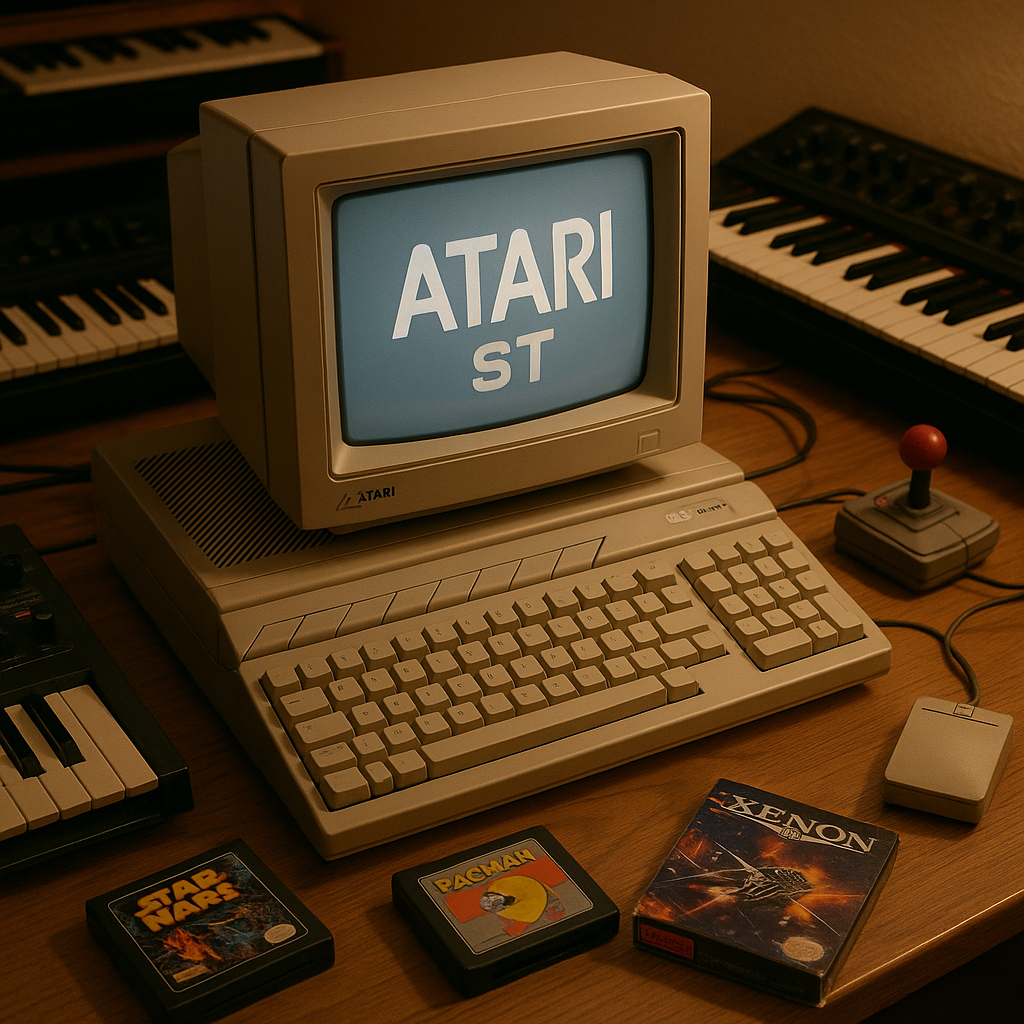
Technical Sheet
| Element | Characteristic |
|---|---|
| Processor | Motorola 68000 @ 8 MHz |
| RAM | 1 MB (expandable to 2 MB) |
| Storage | 3.5″ floppy disks (720 KB) |
| Graphics | 320×200 in 16 colors / 640×400 in 4 colors |
| Sound | YM2149 – 3 channels + noise |
| Interface | MIDI In/Out/Thru, joystick port, parallel port |
Facing the Competition
Amiga 500 vs ST 520
The duel between the Amiga 500 and the ST 520 remains a legendary chapter. The Amiga often won on the graphics and audio side thanks to its custom chips (Paula, Denise, Agnus), but the ST 520 responded “present” with its native MIDI and more affordable pricing. As a result, many owned both, one for fun and the other for production.
Commodore 64 and PC
The Commodore 64 had earlier won over gamers with its SID, but struggled with MIDI without external cards and lacked RAM to house long pieces or large cracks. As for compatible PCs, they remained too expensive and unfriendly for music. To navigate this evolution, the chronology of gaming computers puts these choices and stakes into perspective.
The Legacy of the Atari ST 520
At the turn of the 1990s, the arrival of the CD-ROM and Windows deprived the ST 520 of its supremacy. Yet, its influence endures: many musicians continue to use its MIDI banks, and the demo scene has never truly disappeared. Emulators, retro festivals, and cracktro compilations attest to an intact fascination. In short, this microcomputer proved that accessible hardware could trigger limitless creativity.
FAQ
- Why was the Atari ST 520 favored by musicians?
Because it natively integrated a reliable and easy-to-use MIDI interface, without the need for extensions. - What is a cracktro?
A short graphical and musical introduction added to pirated games, intended to showcase the work of the cracking group. - Can one still program on an ST 520 today?
Yes, thanks to emulators like Steem or Hatari, or even on the original hardware for purists. - How does the Atari ST 520 compare to the modern Amiga?
Both machines had distinct strengths: the ST for MIDI and the Amiga for advanced graphics and audio.
