
At the end of the 1980s, Schneider — Amstrad’s German partner — transformed two synthetic computers into true icons of 8-bit video gaming on the old continent. The CPC 464, with its built-in cassette player, and the CPC 6128, the floppy disk champion, seduced both amateurs and professionals, shaking up the dominance of the Spectrum and Commodore. Without further ado, let’s see how these machines conquered European households.
🎦 Two key models: the CPC 464 (with cassette) and the CPC 6128 (with floppy disk) offered a unique compromise between price and features, making 8-bit truly accessible.
⚙️ Solid architecture: a 4 MHz Z80A, a palette of 27 colors, and up to 128 KB of RAM on the 6128 allowed ambitious developers to push the limits.
📚 Extensive catalog: nearly 3,000 imported and local games, ranging from pure action to sophisticated simulations – enough to rival the Spectrum and Commodore 64.
🌍 European impact: strategically, Schneider distributed these CPCs on a large scale, and neighborhood stores made them the 8-bit reference before the PC arrived in force.
Sommaire
Context and genesis of the CPC
Amstrad, a British brand already strong with its audio and video devices, sought to enter the consumer microcomputer sector. Rather than creating an in-house model, it partnered with Schneider, ensuring optimized distribution and after-sales service in the German-speaking market and beyond. This collaboration gave birth to two configurations: one focused on cassette, the other on floppy disk.
From the professional world to the gamer’s home
Amstrad initially targeted small businesses with the CPC 464. However, the playful and educational software offer, coupled with a tight price, quickly attracted game enthusiasts. Schneider, a savvy expert in the European distribution network, then launched an aggressive strategy to flood the shelves and unite local communities of enthusiasts.
Architecture and technical characteristics
At the heart of both machines, a Zilog Z80A processor clocked at 4 MHz. The display supports three very different video modes, playing on resolution and palette to offer often impressive rendering despite the 8-bit limitations. Sound is generated by a three-channel AY-3-8912, a reliable standard also used in the MSX and Spectrum 128K.
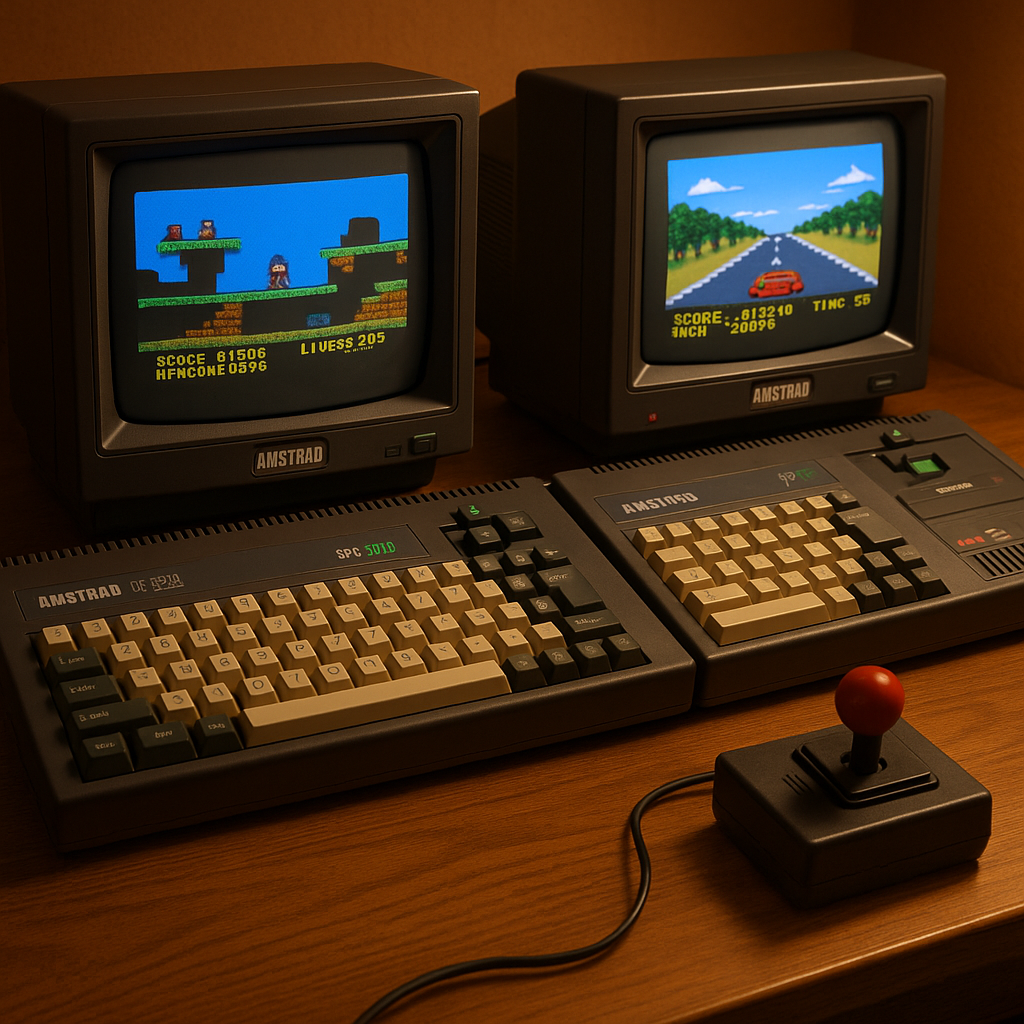
| Element | CPC 464 | CPC 6128 |
|---|---|---|
| CPU | Z80A 4 MHz | Z80A 4 MHz |
| RAM | 64 KB | 128 KB |
| Storage | Cassette (Datacorder) | 3½” Floppy Disk (3″½) |
| Graphics | Mode 0–1–2; 27 colors | Identical |
| Sound | AY-3-8912 (3 channels) | AY-3-8912 (3 channels) |
| Operating system | CP/M (optional) | Integrated CP/M |
8-bit gaming on CPC: a rich catalog
Publishers, attracted by the color palette and the robustness of the Z80, multiplied the titles: lively simulations, text adventure games, adaptations of cult films… To trace the evolution of the hardware and its influence up to today, one can dive into the first microcomputers to modern gaming PCs, where the CPC holds a pivotal place.
- Faithful arcade ports, like Ghosts ’n Goblins or Robocop.
- Original platformers, such as Dan Kurfuerst or Errol.
- Games in mode 1 to focus on finesse, or mode 2 to explode the palette.
Competition and market positioning
Schneider played on the field of service and refined packaging: manuals in several languages, support lines, bundles with color monitors. Facing the giants:
- Spectrum from Sinclair, ultra-affordable entry-level but with basic finishes.
- Commodore 64, sales king but more expensive and less cassette-oriented.
- MSX, widespread Japanese standard, but victim of brand fragmentation.
Impact in Europe and legacy
In a few years, the CPC united user clubs, inspired specialized magazines, and sparked programming contests. Its quality-price ratio pushed households to switch from the living room computer to the family microcomputer. Today, this range serves as a historical reference for collectors and retro developers, proof of a success that far exceeds the ephemeral.
FAQ
- What is the difference between the Amstrad CPC 464 and the 6128?
- The CPC 6128 doubles the RAM (128 KB vs 64 KB) and replaces the cassette with a fast disk drive, facilitating loading and development.
- Why did Schneider, and not Amstrad, dominate the European market?
- Schneider had a dense distribution network in Germany, localized after-sales service, and multilingual marketing, increasing visibility and trust among the public.
- What are the flagship titles on CPC?
- Among the essentials: Ghosts ’n Goblins, Bubble Bobble, and many French productions like Kayleth or Fantôme.
