
| Key Points | Details to Remember |
|---|---|
| 🖥️ Definition | Mega65: modern machine inspired by the C64; C64: iconic microcomputer of the 1980s. |
| ⚙️ Performance | Frequency, Memory, and graphics significantly superior on the Mega65. |
| 💾 Compatibility | 100% of C64 games, plus support for new formats. |
| 🔧 Features | Hardware acceleration, modern connectivity, and expandability. |
| 🎮 Community | Active and dynamic for open source project development. |
The Mega65 reinterprets the famous Commodore 64 by offering a modernized architecture while maintaining full backward compatibility. In this comparison, we detail the performance, software environment, and key features of these two machines.
Sommaire
1. Origins and Design Philosophy
The Commodore 64, launched in 1982, marked the history of home computing with its accessibility and rich game library. The Mega65, the result of an enthusiasts’ initiative, replicates the C64 at both hardware and software levels while improving it in several ways.
1.1 Commodore 64: a pioneer
- 6510 Processor at 1 MHz
- 64 KB of RAM onboard
- Graphics in VIC-II (16 colors)
- Sound in SID (3 channels)
1.2 Mega65: a modernized tribute
- Reconfigurable FPGA to emulate the 6510 and extend its capabilities
- Up to 128 MB of RAM (DDR3)
- Display in 1080p with 24-bit palettes
- Stereo audio 48 kHz via DAC
« Traveling to the past with the power of the present » – unofficial motto of the Mega65 designers.
2. Compared Technical Performance
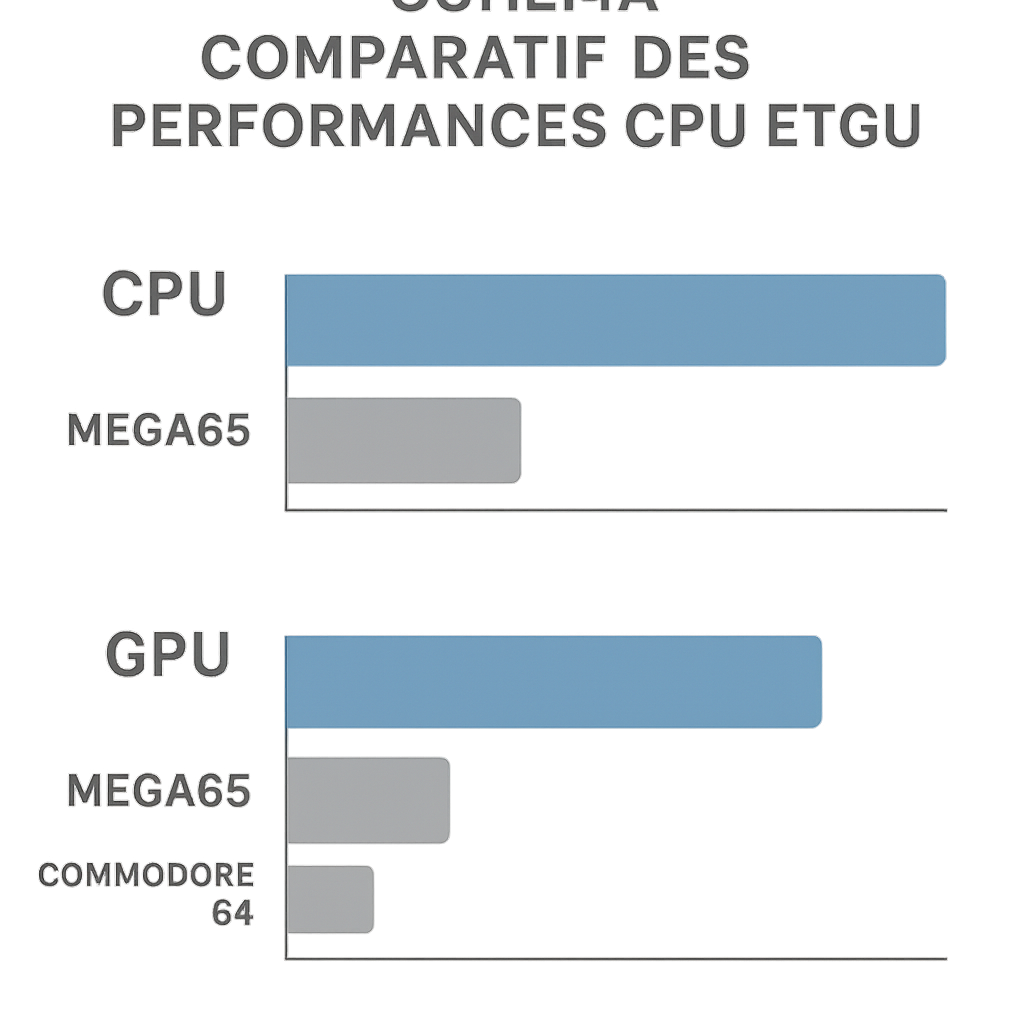
To measure the gap, we can examine the key components: CPU, memory, graphics, and sound. The Mega65 offers specifications that far exceed those of the original C64 while remaining faithful to its architecture.
2.1 Processor and clock speed
The C64 runs at 1.023 MHz, whereas the Mega65 emulates this processor via FPGA but can push the clock to 50 MHz in native mode, multiplying raw power by more than 40.
2.2 RAM
With only 64 KB, the C64 is limited to modest programs. The Mega65, on the other hand, carries up to 128 MB, a 2000× expansion factor, opening the door to demanding applications and basic multitasking.
2.3 Graphics and display modes
| Feature | Commodore 64 | Mega65 |
|---|---|---|
| Resolution | 320×200 | 1920×1080 |
| Colors | 16 | 16.7 million |
| Sprites | 8 (max) | Programmable |
2.4 Audio quality
The C64’s SID remains legendary but limited to 3 channels. The Mega65 adds a modern stereo DAC, providing more fidelity and paving the way for more immersive music and sound effects.
3. Software Compatibility
One of the major strengths of the Mega65 is its ability to run nearly all C64 software, while supporting more modern formats and environments.
3.1 C64 Games and Demos
- Native execution without software emulation or loss of smoothness
- Support for floppy disks and cartridges via adapters
- Confirmed compatibility for more than 95% of the C64 library
3.2 New Developments
Recent projects leverage increased memory and resolution to create new games and applications. These include:
- Text editors and IDEs based on MicroPython
- Simple media players (MP3, WAV)
- Lightweight web servers and modern browsers
4. Features and Extensions
Beyond performance, the Mega65 offers a set of options that modernize usage without betraying the spirit of the Commodore 64.
4.1 Connectivity and Storage
- HDMI and VGA outputs for current monitors
- USB Host for keyboards, controllers, and USB drives
- MicroSD slot for disk images and modern storage
4.2 Hardware Extensions
Thanks to its FPGA, the Mega65 can host additional cores:
- Emulator for Atari and Amiga machines
- Alternative sound cards (Yamaha OPL3, MIDI)
- Specific accelerators for graphic processing
5. Price, Availability, and Community
While the original C64 can be found cheaply on the second-hand market, the Mega65 remains a niche product for enthusiasts:
- Commodore 64 (used): €50 – €100
- Mega65 (new): approximately €600 – €700
An active community publishes firmware, updates, and open-source projects, ensuring continuous evolution of the Mega65.
Key Takeaways
- The Mega65 multiplies CPU speed by 40 and RAM by 2000 compared to the C64.
- Almost perfect backward compatibility with the vast C64 catalog.
- HD graphics, modern stereo audio, and USB/HDMI connectivity.
- Higher price, but supported by a very engaged community.
FAQ
What is the Mega65 and why compare it to the Commodore 64?
The Mega65 is a modernized FPGA replica of the Commodore 64. It is compared to the C64 to measure gains in power, memory, graphics, and features while retaining the charm of the original.
What performances are truly superior on the Mega65?
The Mega65 pushes the clock up to 50 MHz (vs 1 MHz), multiplies RAM by 2000, offers HD resolution and high-fidelity stereo audio, far surpassing the C64 base.
Can you play all C64 games on the Mega65?
Yes, over 95% of titles are natively compatible, thanks to FPGA emulation of the processor and graphics/sound chips.
What new applications are available on Mega65?
MicroPython editors, MP3/WAV players, mini web servers, and even cores to emulate other micros (Atari, Amiga).
What budget should be planned for a Mega65 compared to a used C64?
A vintage C64 sells between €50 and €100, while the Mega65 is priced around €600–700 new. The investment aims for a modernized and scalable experience.
