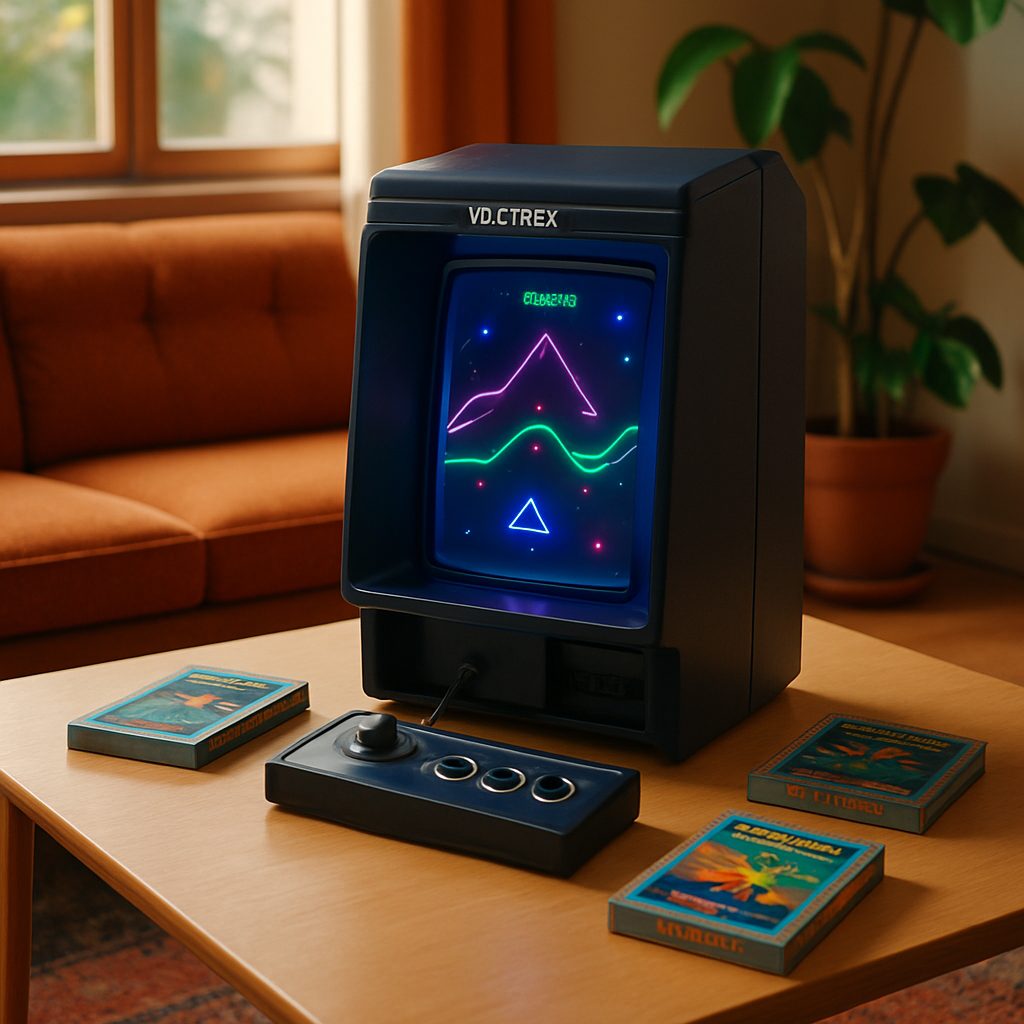
During the video game boom in 1982, Majesco launched the Vectrex, the only machine to offer vector display on a built-in CRT screen. Without relying on a television, it offers a unique visual experience, with sharp geometric shapes, striking contrast, and a sense of depth. Halfway between a home console and a microcomputer, the Vectrex quickly established itself as a cult object, rewarding curious minds and enthusiasts of cutting-edge technologies.
🕹️ Unique vector: built-in vector CRT screen for precise graphics and an atypical immersion.
⚙️ Technical specifications: 8-bit CPU, 1 KB RAM, interchangeable cartridges, and analog controller.
🎮 Library: about thirty official titles, including the legendary “MineStorm” and faithful adaptations of classics.
🏆 Legacy: influence on vector rendering of arcade cabinets and the homebrew scene, now prized by collectors.
Sommaire
Genesis and revolutionary concept
In the early 1980s, most consoles used bitmap rendering on a television. The Vectrex took the opposite approach by integrating its own monochrome CRT screen capable of drawing vector lines. This technical choice, the result of the work of John Ross and the General Consumer Electronics team, aimed to offer graphic sharpness impossible on competing machines. Like the Intellivision or the Atari 5200, the Vectrex sought to differentiate itself through its high-end positioning and visual performance.
From General Consumer Electronics to Milton Bradley
Initially designed by General Consumer Electronics, it passed into the hands of Milton Bradley shortly after its launch. This acquisition slightly altered distribution by targeting the general public and toy chains, rather than specialized electronics stores. Despite a higher-than-average price, the machine found an audience seduced by technological innovation and display quality.
Technical characteristics
Technical specifications
| Component | Detail |
|---|---|
| Processor | Motorola 68A09 at 1 MHz |
| RAM | 1 KB (expandable via cartridges) |
| Display | Monochrome vector on 9″ CRT |
| Storage | 8–32 KB ROM cartridges |
| Control | Built-in analog joystick |
| Audio | AY-3-8912 (3 channels, white noise) |
| Dimensions | 35 × 28 × 12 cm |
| Release year | 1982 (USA), 1983 (Europe) |
CPU, memory, and vector rendering
The choice of the Motorola 68A09, already present in some microcomputers, guarantees compatibility with line calculation routines. The 1 KB of RAM may seem meager, but vector management does not require a bitmap frame; it only needs coordinates and drawing instructions. The graphics circuit, centered around a vector generator, combats flickering thanks to a high refresh rate, often exceeding 50 Hz.
The Built-in CRT Screen
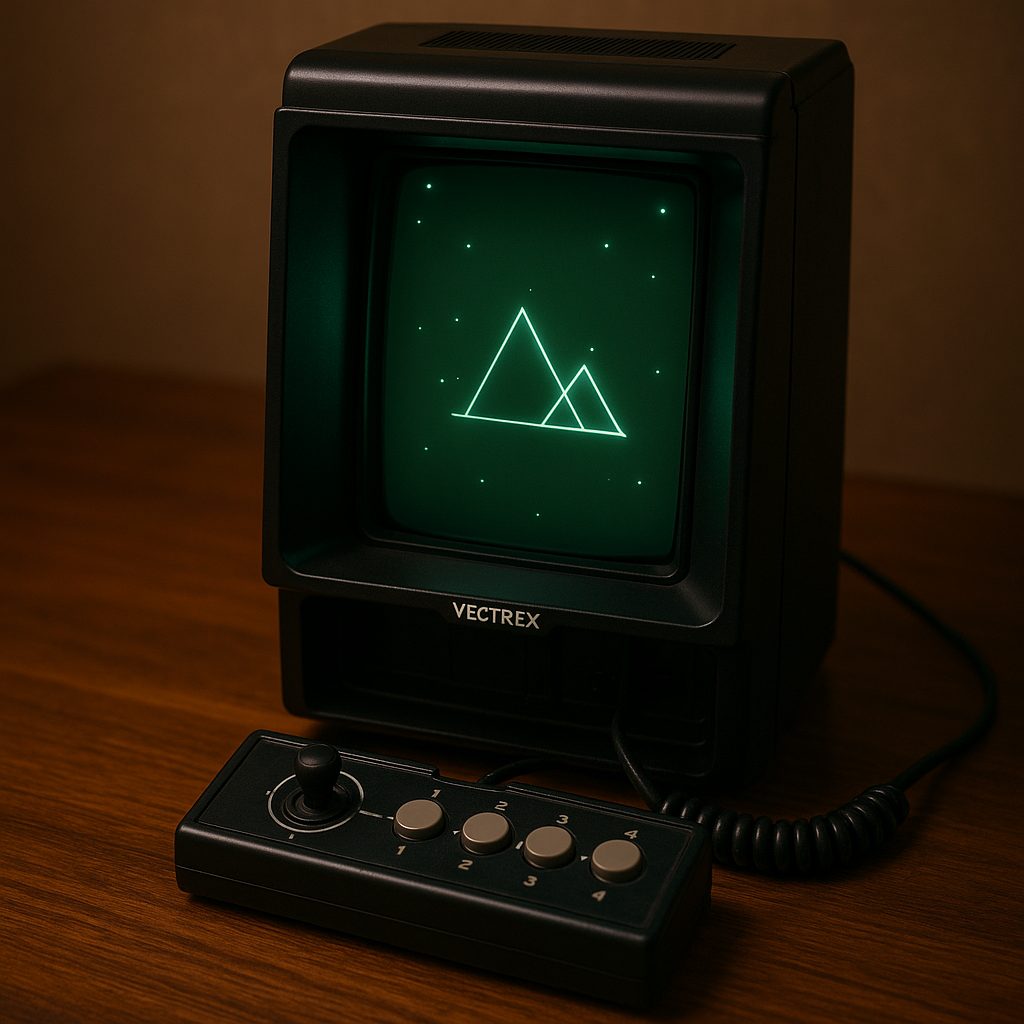
Integrating a cathode ray tube is no trivial matter: space, heat dissipation, and manufacturing costs increase drastically. Yet, this screen offers unmatched sharpness for its time, without depending on the quality of the television. The crisp lines, perfect circles, and absence of bitmap artifacts immerse the player in an almost futuristic universe.
The Game Library and Accessories
With about thirty official titles, the Vectrex focuses on quality rather than quantity. The games, sometimes developed in-house, fully exploit the vector rendering. “MineStorm” remains a technical exclusive, while adaptations of arcade games serve as spectacular demonstrations.
- MineStorm: a reference shooter, free with the console.
- Armor Attack: infiltration and action in a maze.
- Star Ship: a tribute to arcade, intense from start to finish.
- Pole Position: car racing, enhanced speed sensations.
Controllers and Peripherals
The analog joystick, fixed to the console, allows rare precision. Accessories like the matrix keyboard transform the Vectrex into a rudimentary microcomputer, even if this use remains marginal. Later, voice modules and transparent overlays enrich the experience, adding color to the monochrome graphics.
Competition and Place in History
At the same time, the Atari 2600 reigns supreme while the Mattel Intellivision plays the card of simulated 16-bit graphics. Against these giants, the Vectrex stands out by its all-in-one format. One might think that its vector style limits the variety of backgrounds, but it imposes an unforgettable visual signature.
Later, nostalgic players will see, like the Atari Jaguar, that innovation alone is not always enough without a solid ecosystem. Despite its originality, the Vectrex remains a niche, eclipsed by larger catalogs and a more affordable price.
To place the Vectrex in a broader perspective, it is interesting to consult the evolution of video game consoles, which highlights how each generation pushed technological limits, sometimes to the detriment of mass adoption.
Collection and Homebrew Scene
Recent feedback from enthusiasts has revived the production of kits capable of replacing the CRT tube with a modern LCD screen. Open-source projects now offer CMVS (color mobile vector system) versions or hardware emulators. Retro fans are ready to invest to bring back the magic of vector lines.
The enthusiasm for homebrew also expresses itself through the creation of new games, exploiting the same drawing principles. Compilations on PC or Raspberry Pi allow rediscovering these titles in a replica case, faithful to the original.
Frequently Asked Questions
What makes the Vectrex screen so special?
Its vector display on a cathode ray tube allows drawing lines with unmatched sharpness, without visible pixels, offering a rendering close to vector arcade cabinets.
How many official games are in its catalog?
The official library includes about thirty titles, ranging from “MineStorm” to racing and shoot ’em up adaptations.
Can the CRT be replaced by a modern screen?
Yes, several DIY projects offer LCD upgrade kits, reducing power consumption and size while preserving the vector spirit.
What accessories are available to enhance the experience?
There are colored overlays, sound modules, matrix keyboards, and even extensions to program directly on the console.
